Updated October 2026
Most dripping faucets in Philadelphia can be fixed by replacing the cartridge, or the washers and seats inside the handles, which costs far less than a new faucet. Leaks under the sink are usually a supply line, a loose nut or a worn sprayer hose. Replacement makes sense when the body is corroded, parts are discontinued or the finish has worn through.
Most drips are a parts job, not a new faucet
Older two-handle faucets use rubber washers pressed against brass seats. Most single-handle faucets from Moen, Delta, Kohler and Pfister use a replaceable cartridge or a ball assembly. Once we know the type, a drip is usually a repair rather than a new fixture.
We pull the handle and identify the cartridge so the replacement is an exact match, not a guess. If the seat is pitted, we dress or replace it so a new washer actually seals. When a faucet has been leaking under the cabinet for a while, we check the shelf and back panel for rot and look over the sink drain and trap while everything is open.
Rebuild or new faucet: how we decide
We lay out both options when both make sense, and say so when one does not.
| Situation | Rebuild | Replace |
|---|---|---|
| Drip from a sound faucet with parts available | Usually the right call | Not needed |
| Body corroded or cracked | Will not last | The better choice |
| Discontinued cartridge | Only if a match exists | Often simpler |
| You want a pull-down sprayer or a new finish | Does not change the style | The only way to get it |
Why one faucet repair costs more than another
A cartridge swap and a full faucet change sit far apart in price. We tell you which one you are looking at before any parts go in.
- Cartridge or washer typeCommon cartridges are easy to match. Older or discontinued faucets take longer to source.
- Stops under the sinkSeized or leaking stops need replacing before the faucet can be serviced safely.
- Room in the cabinetDeep sinks, disposals and filter systems crowd the space behind the basin.
- Rebuild versus replaceA new faucet adds the fixture cost but often ends repeat repairs.
- Counter and sink holesChanging faucet style may need a deck plate or a new hole cut in stone.
Dripping Cartridges
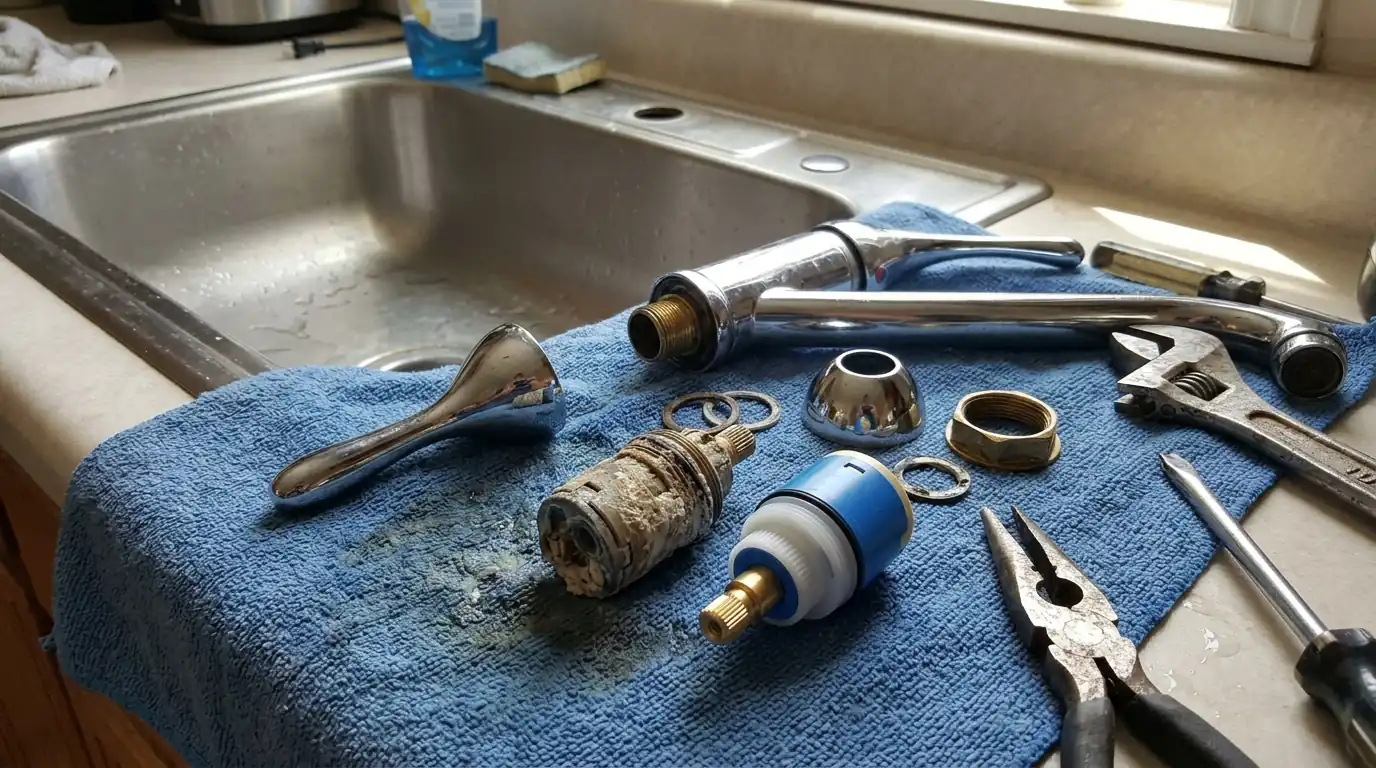
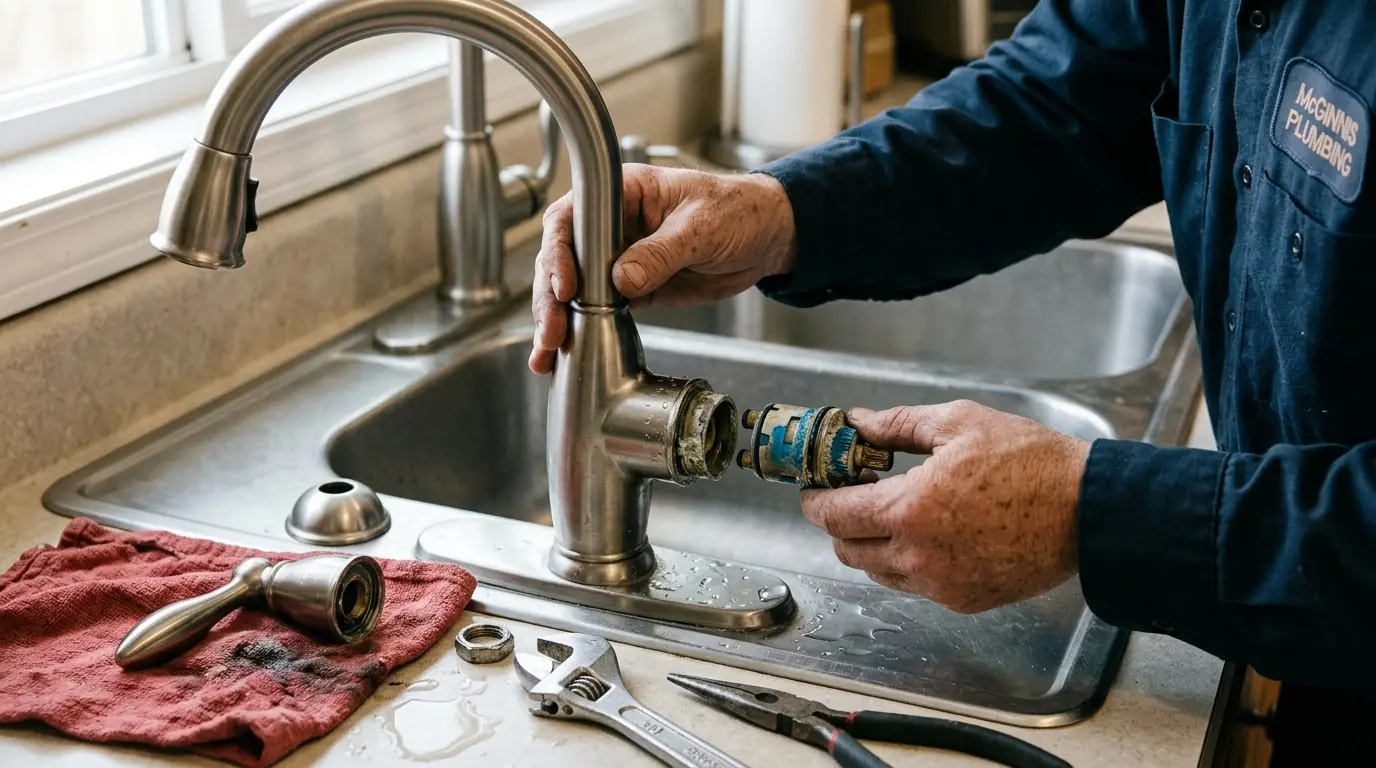
A spout that drips with the handle closed, or a single lever that has to be nudged just so before the drip stops, almost always means the cartridge seals are worn or scaled. On washer-type two-handle faucets the same symptom comes from a hardened washer or a pitted brass seat. We close the stops, take off the handle and retaining clip, and pull the cartridge so we can match it by part number rather than by eye. A new cartridge, or new seats and springs, or a washer and seat on older faucets, usually ends the drip.
Leaks Under the Sink
Water in the sink cabinet is easy to blame on the faucet when the faucet is innocent. The supply lines, the compression nuts on the stops, the hose on a pull-down sprayer, the basket strainer and the drain tailpiece can all drip onto the same shelf. We dry everything, set paper towels under each joint and run the faucet and the sink drain separately to see which one wets first. Old vinyl or chrome supply tubes are replaced with braided lines, and a pull-down hose that splits where it loops gets a replacement from the maker.
Faucet Replacement
Some faucets are not worth another cartridge: a corroded base, a cracked spout, a finish worn through to brass, or a model so old the parts are gone. Others are simply not the faucet you want any more. When we replace one, we remove the old faucet, clean the deck, check the sink holes against what the new faucet needs and fit a deck plate if there are spare holes. New supply lines go on every time. Single-hole pull-downs, widespread bath sets and bar faucets all mount differently, so the number of holes in the sink or counter often decides which models will work without drilling.
Faucet trouble you can spot
Drip from the spout with the handle off
A worn cartridge, washer or valve seat is letting water slip past.
Water pooling around the handle base
O-rings on the cartridge or swivel spout have dried out.
A handle that grinds or sticks
Scale has built up on the cartridge or stem.
Weak or spitting flow
The aerator screen is packed with scale or with grit stirred up by work on the water main.
A damp cabinet floor
A supply connection, the sprayer hose or the base gasket is weeping.
From drip to dry, how a faucet visit works
Find the leak path
We dry the faucet and cabinet, then run the water and watch where it reappears.
Shut the stops
Both stops under the sink are closed and tested. Stuck stops are noted before we start.
Pull and identify parts
Handle and cartridge or stem come out so the replacement is an exact match.
Rebuild or replace
New cartridge, washers, seats and O-rings, or a new faucet with fresh supply lines.
Flush and test
Aerator off, lines flushed of debris, then the faucet run hot and cold with the cabinet checked.
Scale and Philadelphia faucets
PWD's 2024 water quality report puts Philadelphia water in the moderately hard to hard range, with one-year averages of 98 ppm hardness at Baxter, 152 ppm at Belmont and 168 ppm at Queen Lane. Faucets feel that first. Scale stiffens cartridges, roughens the brass seats on older two-handle sets and packs aerator screens until the stream spits. When we rebuild a faucet in Philadelphia, we clean the scale out of the body before seating new parts, because a fresh cartridge in a crusted housing starts dripping again.
Questions about faucet repair in Philadelphia
The brass seat under the washer is probably pitted. A new washer cannot seal against a rough seat, so replacing or dressing the seat usually fixes it.
If the body is sound and the cartridge is available, a rebuild usually wins. If it has leaked more than once, replace it.
Yes. Check that it matches the number of holes in your sink or counter, or send us the model and we will check before the visit.
Unscrew the aerator first. After main work on the block, grit can pack the screen. If cleaning it does not help, the cartridge or supply lines may be clogged.
Yes, though those are a different fixture. Hose bibs that leak or split in a freeze are handled under outdoor faucet repair.