Updated October 2026
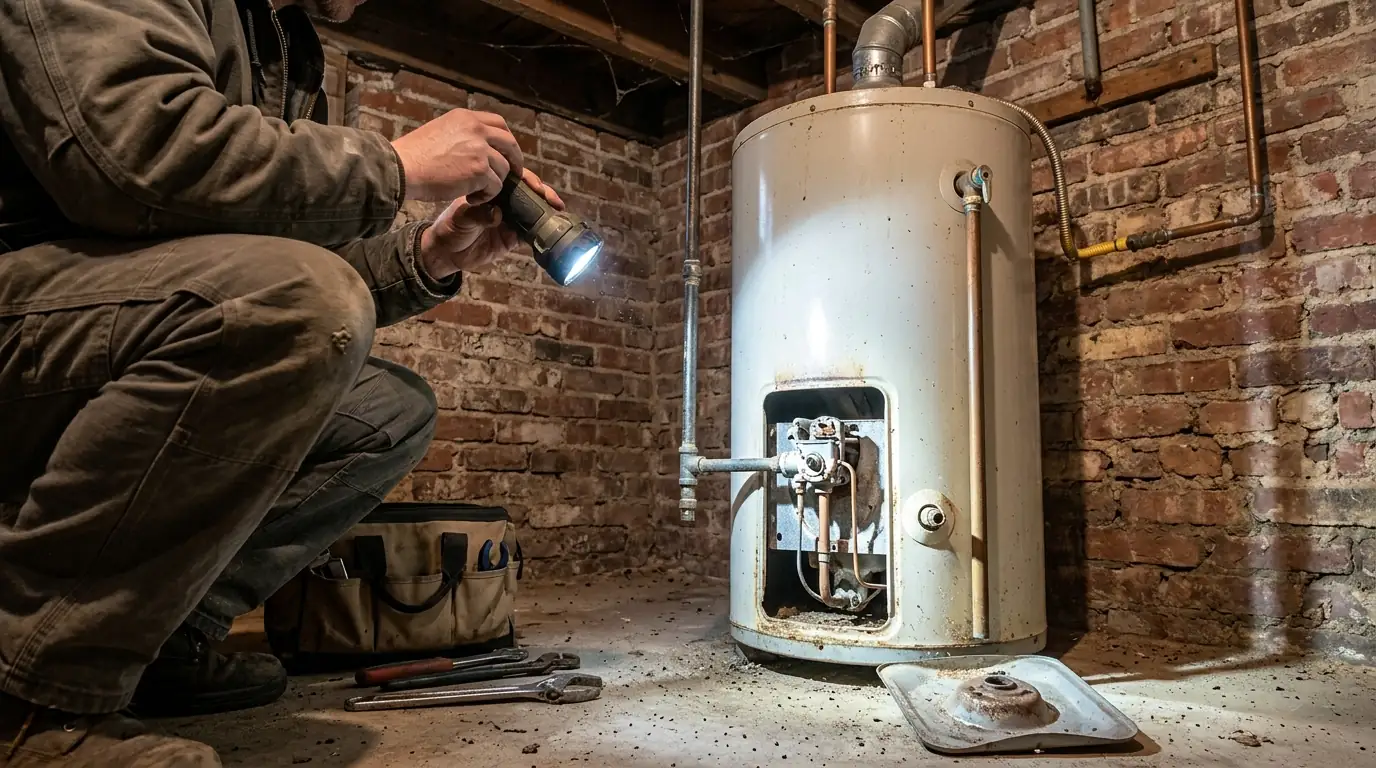
Most Philadelphia water heater repairs come down to a handful of parts: the thermocouple or flame sensor on a gas tank, the heating elements and thermostats on an electric one, or a leaking relief or drain valve. All of those are repairable. A tank that leaks from the steel shell itself cannot be fixed and has to be replaced.
What a failing water heater tells you
Hot water runs out early
Showers go lukewarm halfway through. On electric tanks a dead lower element is the usual reason; on gas tanks, heavy sediment can be.
The pilot goes out again and again
A weak thermocouple, a dirty pilot tube or a draft across the burner keeps knocking the flame out.
Water on the floor by the heater
It may be a valve, a fitting or condensation. A drip from under the jacket usually means the tank itself.
Repair or replace: how we decide at the tank
A gas tank heats with a burner, pilot, thermocouple and gas control valve; an electric tank uses two elements and two thermostats. When one of those parts fails, a repair puts the heater back in service for far less than a new unit.
The tank is the limit. Once the steel lining rusts through, water seeps from under the jacket and no part swap stops it. If we find that, we say so plainly and talk through putting in a new tank rather than charging for a repair that will not hold.
Pilot and Thermocouple Problems
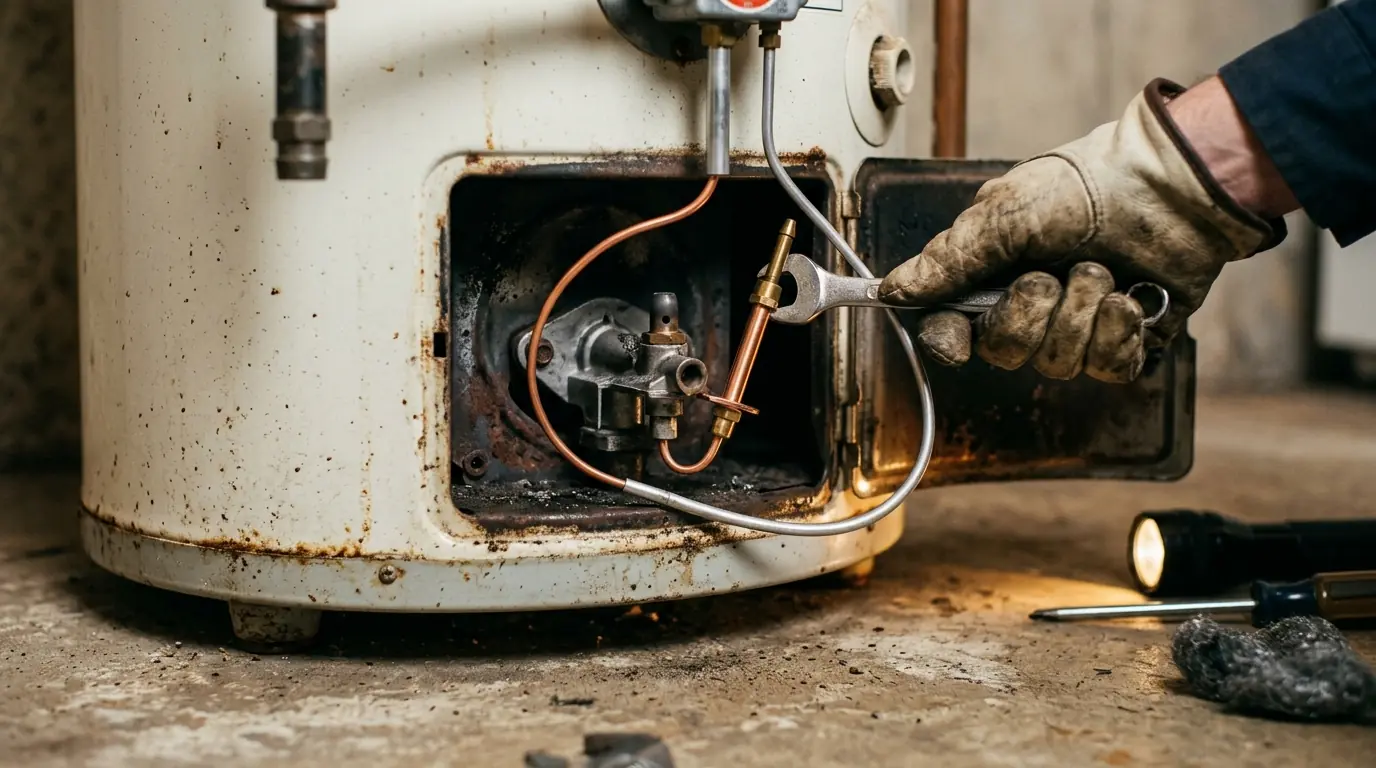
On a standing pilot gas heater, the thermocouple sits in the pilot flame and tells the gas valve it is safe to stay open. When it weakens, the pilot lights while you hold the button and dies the moment you let go. A clogged pilot orifice gives the same symptom with a small, lazy yellow flame. We clean the pilot assembly, test the thermocouple output and replace it or the gas control valve as needed. We also check that the flue is drafting, because a heater that cannot vent will keep shutting itself down.
Electric Element Failures
An electric tank with no hot water at all usually has a tripped high limit or a burned upper element. If you get some hot water but it runs out quickly, the lower element has probably failed. Hard water speeds this up, since scale crusts on the elements until they overheat and crack. We shut the power at the panel, test each element and thermostat with a meter and replace whatever reads bad. A tank packed with scale gets flushed first, and a yearly flush keeps it that way.
Leaking Valves
Not every puddle means a dead tank. The temperature and pressure relief valve can drip when it is worn, or when pressure in the house climbs as the water heats, which often points to a missing or failed expansion tank. Plastic drain valves at the bottom of older tanks crack, or stop sealing after someone opens them. The cold inlet and hot outlet nipples can corrode where they thread into the tank. We dry everything off, find the exact source and replace the valve or fitting. If the relief valve is discharging, we test the house pressure before blaming the valve.
From a cold shower to hot water again
Check the basics first
We confirm the gas supply and pilot or igniter, or on electric tanks the breaker and high limit reset.
Test the suspect part
Meter readings on the thermocouple, elements or thermostats show which part is bad instead of guessing.
Replace and adjust
The failed part comes out, the new one goes in and the thermostat is set to a safe temperature.
Watch a full heat cycle
We stay while the burner or elements run a cycle and confirm the valves and fittings stay dry.
Water heaters in Philadelphia basements
In a lot of Philadelphia rowhomes and twins the water heater stands in the basement near the meter and the main drain, which keeps it easy to reach but means a leak lands on whatever is stored nearby. Water hardness shapes the repairs too. PWD's 2024 water quality report puts one-year hardness averages between 98 and 168 ppm across its treatment plants, moderately hard to hard, so scaled elements and sediment-choked burners are regular findings when we open a heater up.
What a water heater repair usually costs
The part that failed sets most of the price. A thermocouple is a small job; a gas control valve, or a pair of elements and thermostats, costs more in parts and time.
- Which part failedThermocouples, igniters and drain valves are inexpensive; gas control valves are the costly ones.
- Gas or electricElectric repairs often mean elements and thermostats in pairs, while gas repairs center on the burner and control.
- Sediment in the tankA tank packed with scale may need flushing before the repair is worth doing.
- Age and condition of the tankOn an old tank with rust at the base, we will tell you if the money is better spent on a new heater.
Water heater checks you can make before calling
A few checks are safe and can save a visit. Anything involving gas parts or the wiring behind the access covers is for a plumber.
| Task | Safe to do yourself | Call a plumber |
|---|---|---|
| Relight a pilot using the label on the tank | Yes, if there is no gas smell and you follow the printed steps. | If it will not stay lit, or you smell gas at any point. |
| Lift the relief valve lever to test it | Not on an old valve. It may not reseat and will keep dripping. | We test it with a replacement on hand. |
| Replace an electric element | No. Live wiring and a full tank make it risky. | Always. We drain, test and replace. |
Questions about water heater repair in Philadelphia
The usual causes are a worn thermocouple, a dirty pilot orifice or a draft blowing across the burner. A blocked flue can also make a heater shut itself off. If the pilot dies again after relighting, call rather than keep relighting it.
A valve drip caught by a pan can wait for a booked visit. Water from under the jacket means the tank has failed, so close the cold valve and call us.
On electric tanks a failed lower element is the usual cause; on gas tanks, heavy sediment or a broken dip tube. Both are repairable.
We repair the tank heaters most Philadelphia homes have, including Bradford White, Rheem and A. O. Smith units. Parts for common models are easy to get.
When the shell leaks, or an old, rusty heater needs an expensive gas control. Our replacement cost guide shows what a new heater involves.