Updated October 2026
Tankless water heater service in Philadelphia centers on descaling, because the city's moderately hard to hard water leaves scale in the heat exchanger. A visit flushes the exchanger with a descaling solution, cleans the inlet water filter and burner air intake, and checks ignition and flame sensing. Error codes that keep coming back usually trace to one of those.
Keeping a tankless heater firing every time
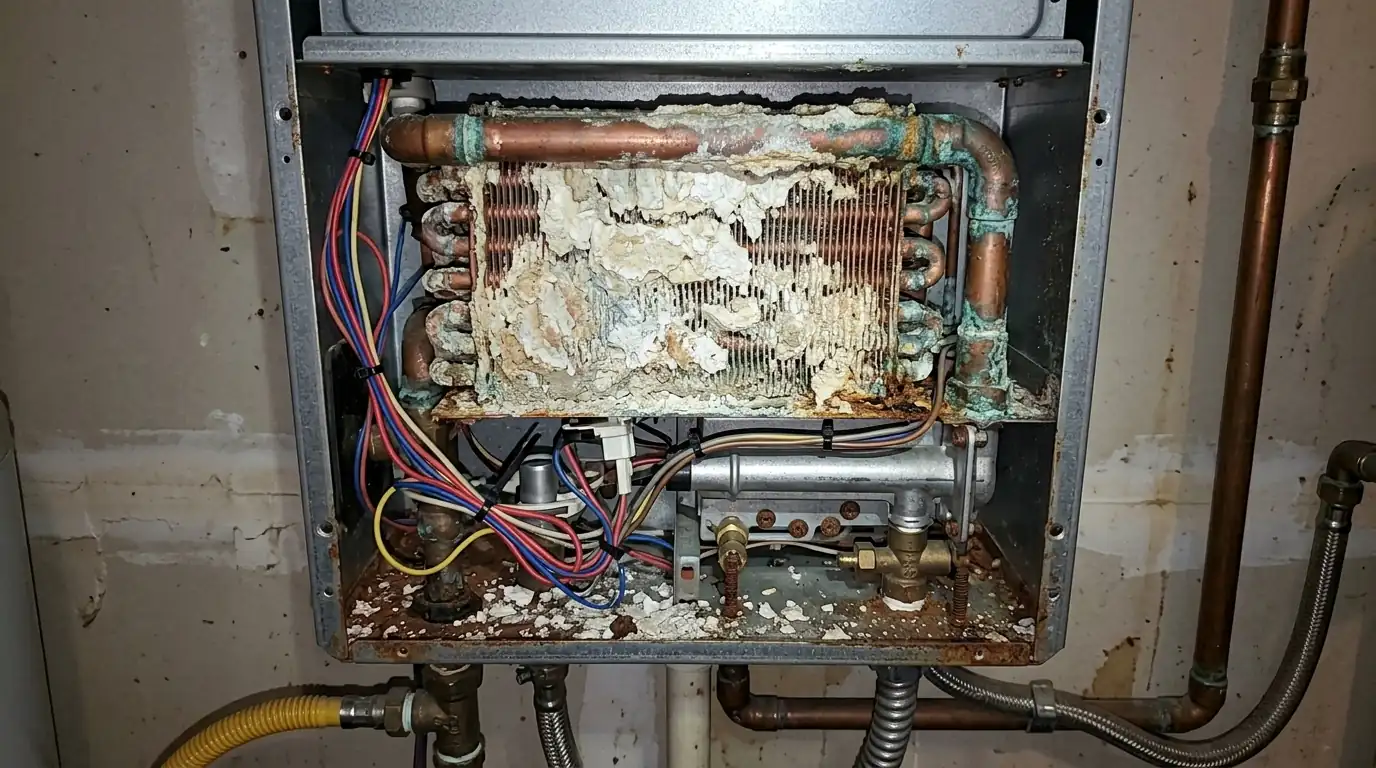
A tankless heater does its work in a compact heat exchanger with narrow water passages. As scale builds inside, the unit works harder, the exchanger runs hotter and the controls start throwing codes. Left long enough, scale damages the exchanger itself, the costliest part in the box.
Service catches that early. We work on common units from makers such as Rinnai, Navien, Noritz and Rheem, and read the stored error history where the unit keeps one. If your heater went in without isolation valves, we add them so descaling becomes a simple job from then on.
Annual Descaling
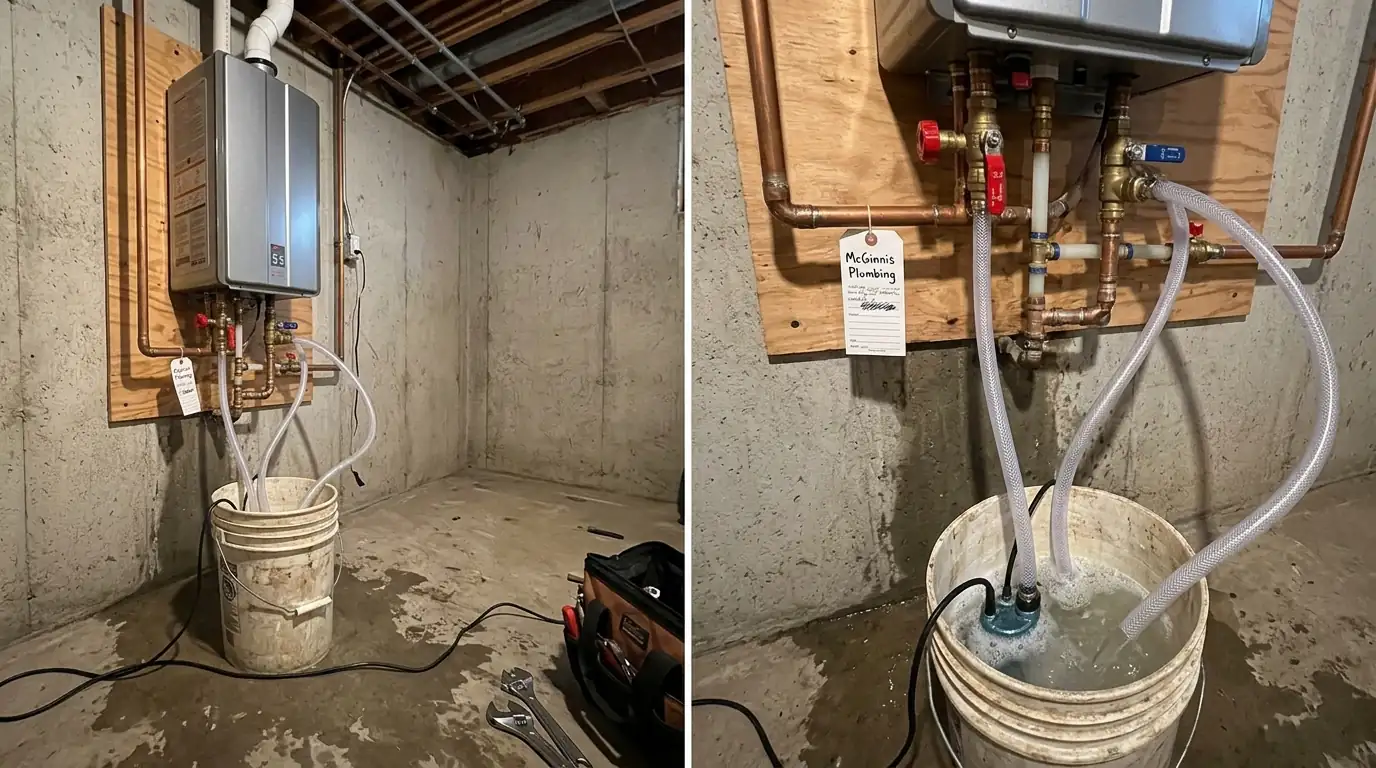
Descaling is the core of tankless upkeep. We shut off gas and power, close the isolation valves and hook up a small pump that circulates descaling solution through the heat exchanger for a set period. Then the solution is flushed out with clean water, the valves reopened and the inlet filter screen cleaned while the unit is still off. The payoff is quieter running and steadier temperature at the tap. How often it is needed depends on how hard the water is and how much hot water the house uses, and the error history usually tells us whether the interval is right.
Ignition and Flame Errors
When a tankless unit tries to fire and gives up, the display shows an ignition or flame failure code. The cause may be low gas pressure, a dirty flame rod, a cracked igniter, a blocked air intake or a vent that is leaking or obstructed. Clearing the code and walking away fixes nothing. We measure gas pressure with the unit at full fire, clean or replace the flame rod and igniter, check the condensate drain and inspect the vent and intake for nests or ice. If the gas line was undersized from day one, we explain what a correctly sized line would take.
Cold Water Sandwich
The cold water sandwich is a slug of cold water between two runs of hot, usually felt when someone shuts the shower off and turns it back on. The unit stops between uses and takes a moment to fire again, so the water in the pipe goes hot, then cool, then hot. A little of that is normal. When it is severe, a minimum flow setting, a scaled flow sensor or a long pipe run to the bathroom can be making it worse. We check the flow sensor, adjust settings where the unit allows and, where it makes sense, look at a small buffer tank or recirculation.
Signs your tankless unit is due for attention
A scale or limescale code
Many units flag buildup with a code once the exchanger starts running hot.
Hot water that drops out at low flow
If the water goes cold when you turn the tap down, the unit may not be sensing flow.
A longer wait for hot water
A dirty inlet screen or a scaled exchanger slows the unit down.
Banging or whistling while it runs
Scale and debris in the exchanger make noise as water boils in hot spots.
How we service a tankless unit
Read the history
We pull the stored codes and ask how the unit has been behaving.
Isolate and descale
Gas and power go off, the valves close and the pump runs solution through the exchanger.
Clean and inspect
The inlet filter, flame rod and air intake are cleaned and the vent looked over.
Test under load
We restart it, run hot water at several taps and check gas pressure and outlet temperature.
What changes the price of tankless service
A routine descale is a set amount of work. Repairs found along the way add parts.
- Service valvesUnits without isolation valves need them fitted before the first descale.
- Scale buildupA heavily scaled exchanger may need a longer cycle or a second pass.
- Ignition partsFlame rods, igniters and fans add parts cost when they fail.
- Vent and condensateClearing a blocked condensate line or resealing a vent joint adds time.
Philadelphia scale and tankless heat exchangers
The water reaching Philadelphia homes is moderately hard to hard, with PWD's 2024 report listing one-year hardness averages of 98, 152 and 168 ppm at its three treatment plants. In a tankless unit those minerals have almost no room to settle, so they bake onto the inside walls of the heat exchanger instead. Harder water means more frequent descaling, which is why we set each customer's interval from the unit's own history rather than a calendar.
Tankless upkeep you can do, and what to leave to us
Some tasks suit a handy owner with the right pump and valves. Anything inside the front cover does not.
| Task | Safe to do yourself | Call a plumber |
|---|---|---|
| Clean the inlet water filter screen | Yes, with the water and power off. | If the screen is torn or the housing leaks. |
| Clear leaves from the outside vent cap | Yes, if it is reachable from the ground. | If the vent is damaged or up on a roof. |
| Descale with a pump kit through the service valves | Possible, if the valves are already fitted. | If there are no service valves or the code returns. |
| Open the cover to clean the burner or sensor | No. Gas and live wiring sit inside. | Always. |
Questions about tankless water heater service in Philadelphia
Repeating codes usually point to scale, a dirty filter, a gas supply problem or a vent issue. Clearing the code without finding the cause only buys time.
If the unit has service valves and you own a pump kit, it is possible. Without those valves, or if codes come back afterward, it is time for a plumber.
A short burst of cooler water is part of how tankless units work. A long or severe one is worth checking, since a scaled sensor or a setting can be behind it.
Yes. We service common makes whoever put them in, and add service valves if they are missing.
A leaking heat exchanger on an older unit is the usual point to think about replacing it. We will show you the leak and talk through a new tankless unit or a return to a tank.