Updated October 2026
A tankless water heater installation in Philadelphia is more than hanging a box on the wall. The unit needs a gas line big enough for its burner, a vent run through an outside wall or roof, a condensate drain on condensing models and service valves for descaling. Sized right, it delivers hot water continuously to the fixtures it was planned for.
What a tankless heater needs to work well
A tankless heater fires a large burner only while a hot tap is open. That is why it never runs out, and also why it needs far more gas at that moment than a tank does. Most of the trouble we find on other installs comes from undersized gas lines and vents run the cheap way instead of the right way.
We size the unit from your fixtures: how many showers might run at once, plus a dishwasher or washer. Units from makers such as Rinnai and Navien are common choices, and we fit what suits the house. If you are still deciding, read our rowhome tank vs tankless comparison first.
Tankless or a new tank: which fits your house
Tankless is not the answer for every home. These are the trade-offs we talk through before you decide.
| Question | Tankless | Tank |
|---|---|---|
| Hot water supply | Continuous, up to the unit flow rating | Runs out once the stored volume is used |
| Space | Hangs on a wall, frees the floor | Takes floor space in the basement |
| Gas line | Often needs a larger line from the meter | Usually works on the existing line |
| Upkeep | Descaling, more often with hard water | Flush and anode check |
| Upfront price | Higher, with gas and vent work | Lower for a like-for-like swap |
What a tankless install costs and why it varies
Tankless installs vary more than tank swaps, because the gas and vent work depends on the house.
- Unit size and typeCondensing units cost more but vent with plastic pipe; non-condensing units need stainless vent.
- Gas line workA new or larger line from the meter is often the biggest extra.
- Vent routeA short run through a basement wall costs less than a long run to the roof.
- Condensate and powerA drain or pump and an outlet near the unit may need adding.
- Tank removal and permitThe old tank comes out, and a permit is pulled when the job needs one.
Tank to Tankless Conversion
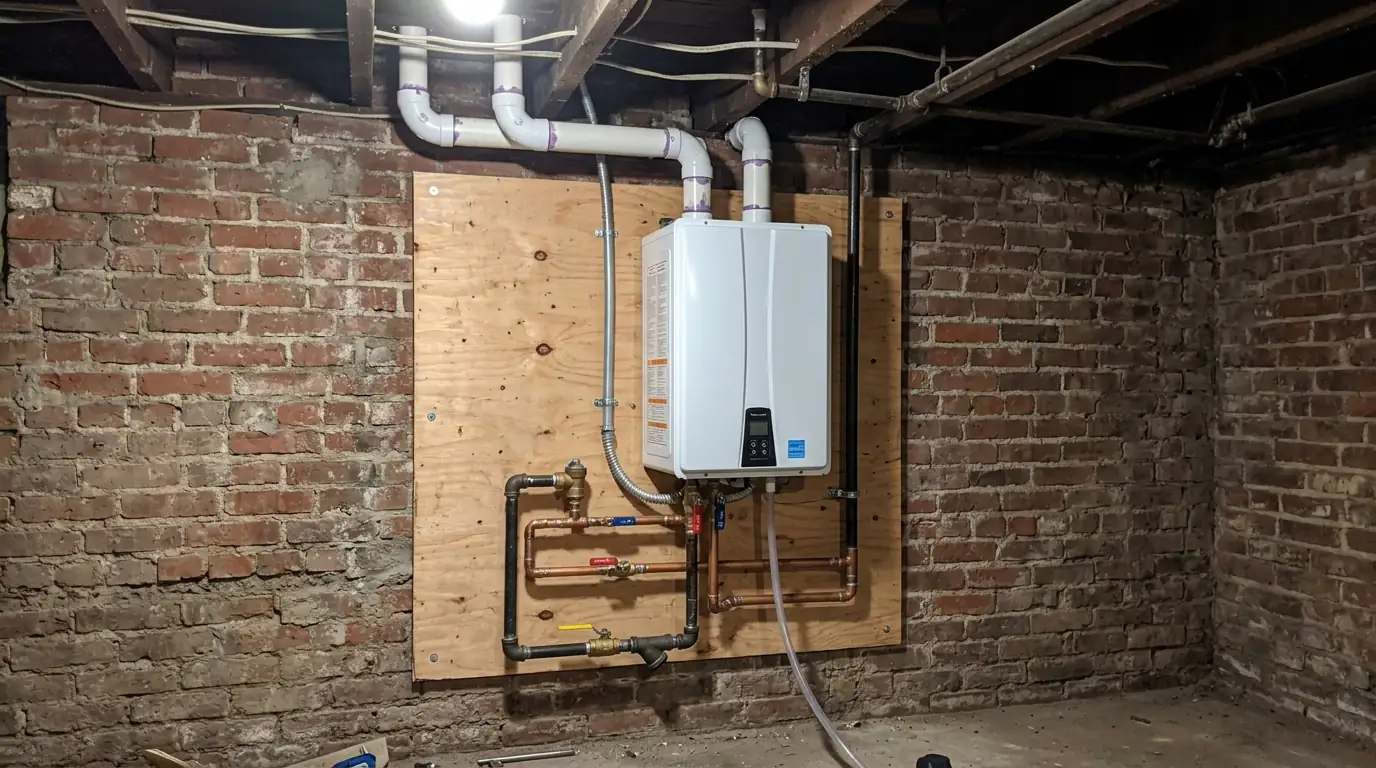
Converting from a tank changes the basement layout. The old tank comes out, the hot and cold lines are rerouted to where the unit will hang, and a condensate line has to reach a drain or a small pump. Atmospheric tanks usually vent into a chimney the tankless unit cannot use, so that flue opening is capped properly and a new vent goes out through the wall. We also look at what else shares the old chimney. If a furnace or boiler still vents into it, taking the water heater off that flue can change how it drafts, and we check that before we leave.
Venting Through a Rowhome Wall
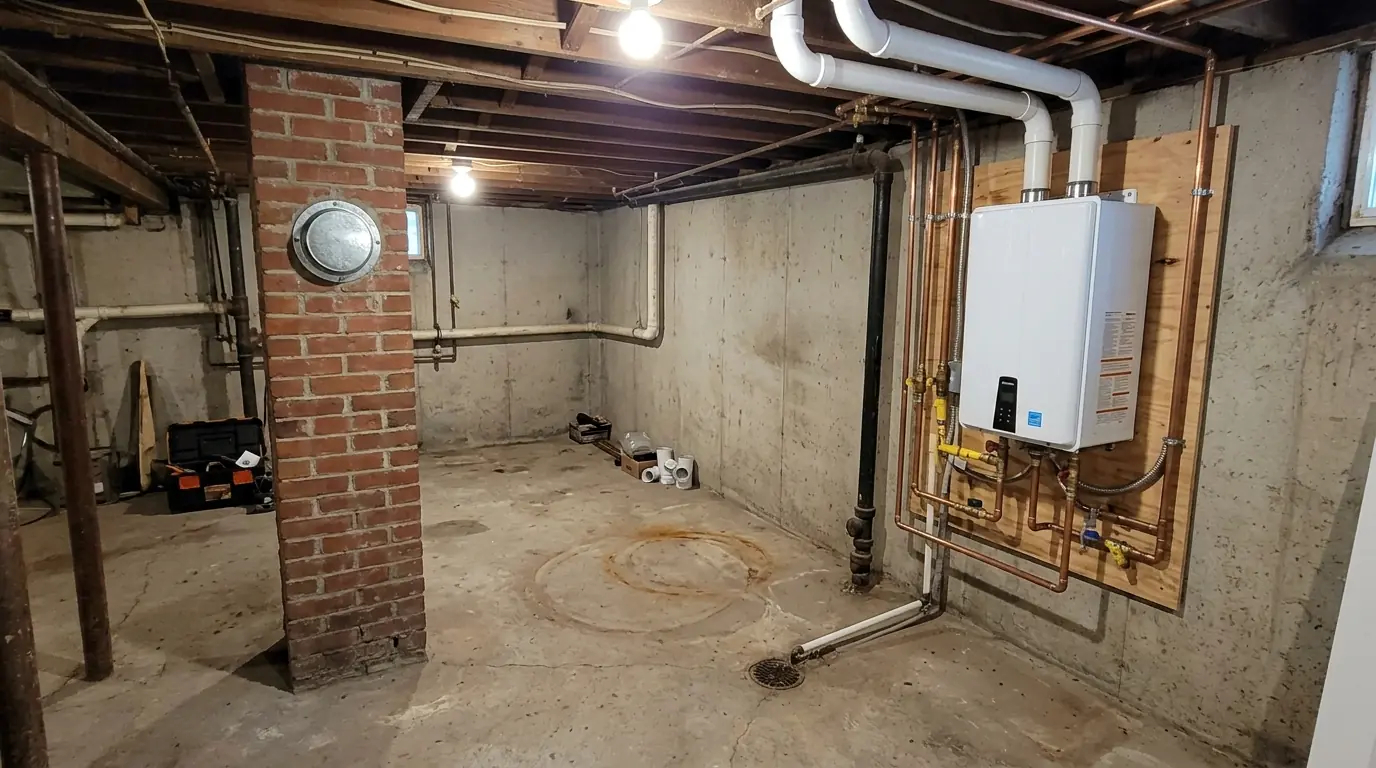
Rowhomes and twins leave little wall space for vent terminations. The vent has to keep its distance from windows, doors, the neighbor's openings, the gas meter and the sidewalk, and on a tight lot that narrows the choices quickly. Condensing units can use plastic vent pipe and side wall terminations, which helps. We plan the route before the unit goes up, sometimes through the front or rear basement wall and sometimes up to the roof. Where no wall location meets the clearances, we tell you that and look at a different heater rather than forcing the install.
Gas Line Upsizing
A tankless burner can draw several times the gas of a standard tank. The small line that fed the old heater is often too narrow, especially when a furnace, range and dryer share it. An undersized line shows up as error codes and lukewarm water whenever other appliances run. We add up every appliance on the system, measure the pipe length from the meter and size the new run from those numbers. Sometimes a dedicated line from the meter is cleanest. All new piping is pressure tested before the gas goes on, the same as any new gas line we run.
Everything that goes into a tankless install
We quote the whole installation, not just the unit, so the gas and vent work is in the number from the start.
- Load calculation based on your fixtures
- Removal of the old tank
- Mounting board and unit hung on the wall
- Gas line sized and run from the meter or an adequate branch
- Vent pipe through the wall or roof with the right clearances
- Condensate drain and neutralizer on condensing units
- Isolation valves for future descaling
- Gas pressure test and first fire
From the walk-through to the first hot shower
Walk-through and sizing
We count fixtures, check the gas meter and existing piping and plan the vent route.
Rough in gas and vent
The new gas line and vent pipe go in before the unit is hung.
Hang and pipe the unit
It goes on the wall with water lines, service valves and the condensate drain.
Test and fire
The gas piping is pressure tested, the unit fired and gas pressure checked at full burn.
Hand over
We show you the error display, the service valves and when descaling is due.
Tankless heaters and Philadelphia water
Hard water is the main upkeep issue for a tankless heater in Philadelphia. The heat exchanger passages are narrow, and the 2024 PWD report shows one-year hardness averages ranging from 98 to 168 ppm across the city's treatment plants, moderately hard to hard. Scale builds in those passages faster than it builds in a tank. That is why every unit we install gets isolation valves for flushing, and why some owners pair it with a water softener.
Questions about tankless water heater installation in Philadelphia
Usually, if the gas service and a vent route allow it. The gas line and the wall clearances are the two things we check first.
Its burner draws far more gas while running than a tank burner does. A line that is too small starves the unit and causes errors or cold water.
Most cannot use an existing masonry chimney. They need their own vent pipe, usually out through a wall.
With moderately hard to hard water, yearly descaling is a sensible starting point. Our tankless service visit covers it.
Yes. The controls, fan and igniter need an outlet, so the unit will not fire during a power outage.