Updated October 2026
Whole house repiping in Philadelphia usually means replacing old galvanized steel supply pipe that has rusted nearly shut. We run new PEX or copper from the meter valve to every fixture and appliance, reuse existing chases and openings where we can, and pressure test the new system before any wall is closed. Drain piping is a separate job unless you ask us to include it.
Why galvanized supply pipe gives out
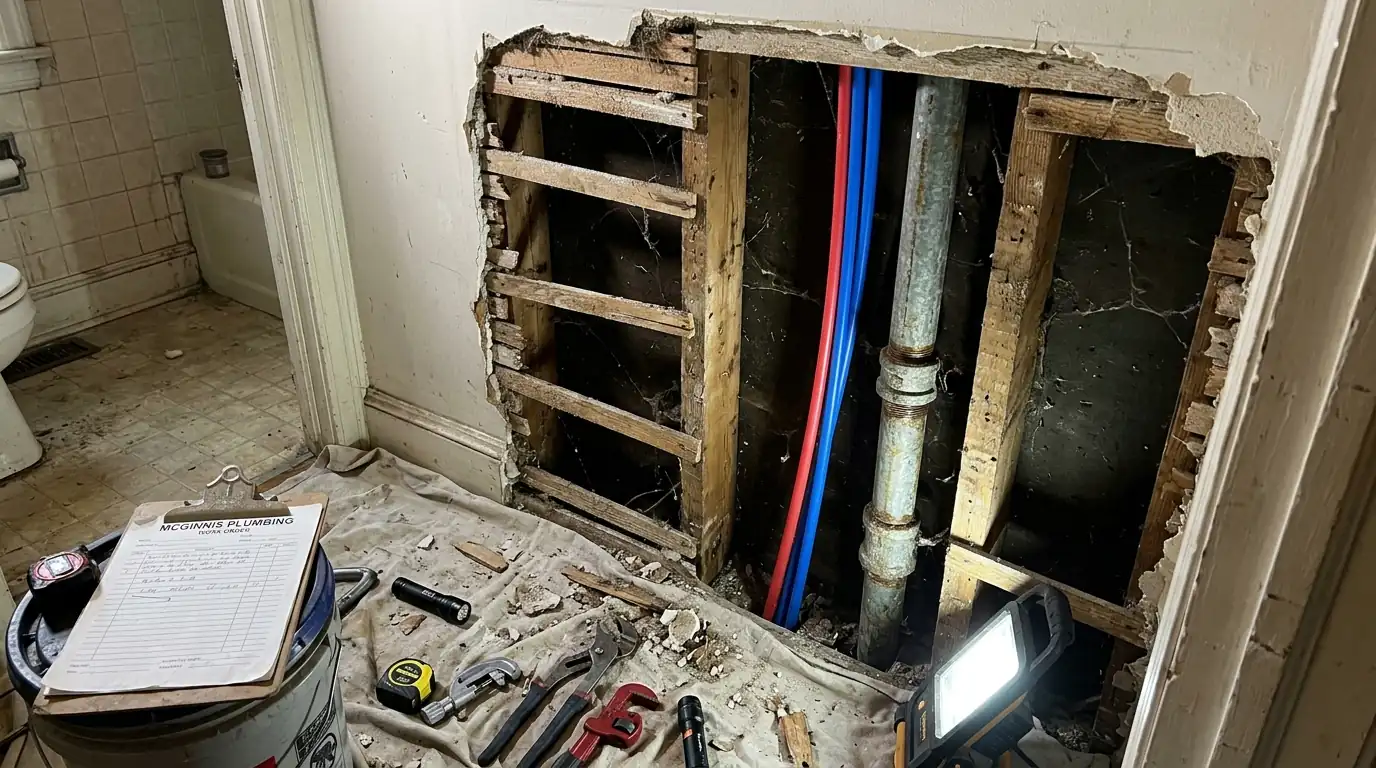
Galvanized steel supplied generations of Philadelphia homes. Its zinc lining wears away, rust builds inside, and a pipe that once carried plenty of water passes a trickle. Water runs brown after sitting and threaded joints weep.
Patching one leak on galvanized pipe tends to move the failure to the next joint. Replacing the system at once costs more up front but ends that cycle. If only one branch is bad, a leak repair or a partial repipe may be enough, and we will tell you so.
PEX or copper for a Philadelphia repipe
Both carry water for decades when installed well. They differ in how they go in and what they cost.
| Question | PEX | Copper |
|---|---|---|
| How it runs | Flexible, long runs with few fittings | Rigid lengths joined at every turn |
| Wall openings | Fishes through existing openings more easily | Usually needs more access holes |
| Freezing | Stretches somewhat before it splits | Splits when the water inside freezes |
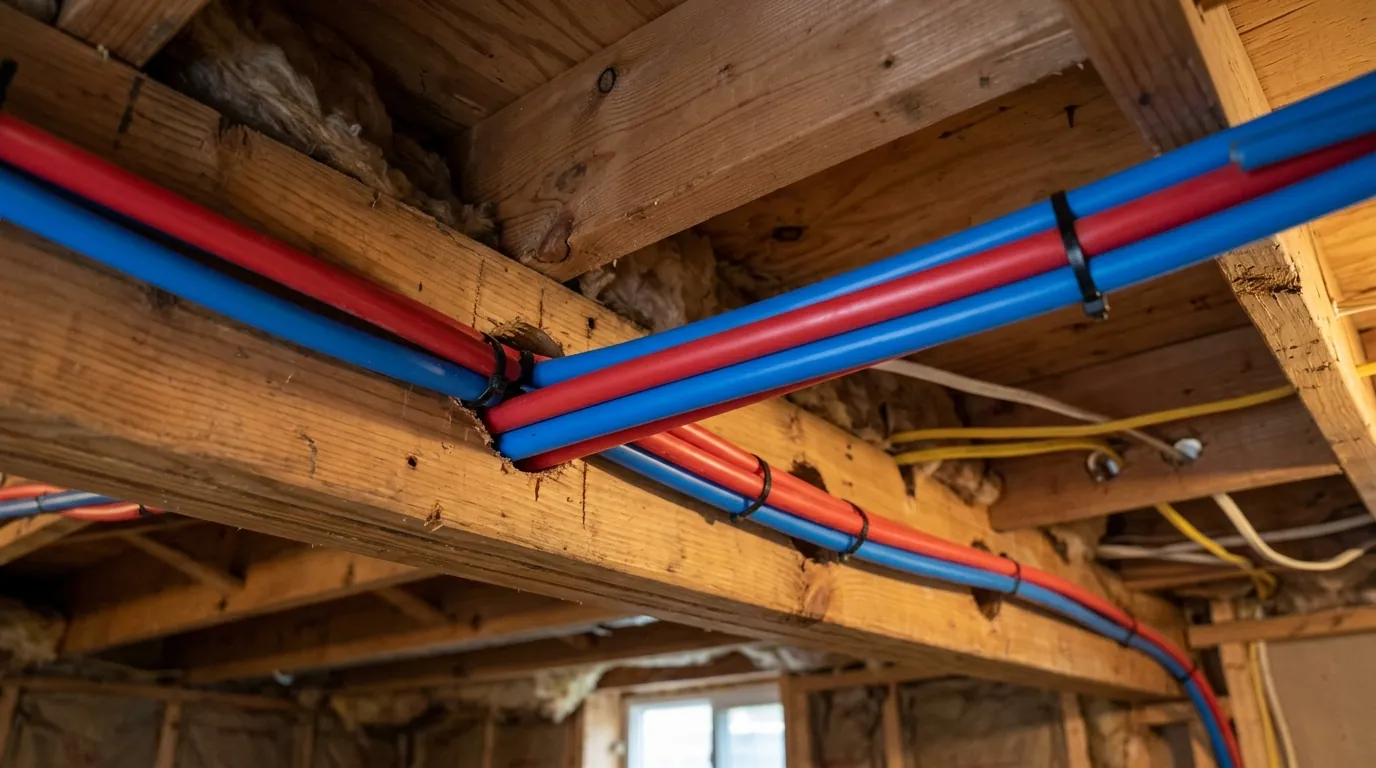
| Open basement joists | Needs straps and protection from sunlight | Neat and durable when left exposed |
| Material cost | Lower | Higher |
Why repipe prices vary so much
Two houses with the same number of bathrooms can price very differently. Access is usually the reason.
- Number of fixturesEvery sink, toilet, tub and appliance needs its own hot and cold run.
- Floors and wall finishPlaster on lath takes more care to open than drywall, and a third floor adds length.
- Material choiceCopper costs more in material and labor than PEX for the same layout.
- Permit and inspectionWe include the permit and inspection when the job needs them.
Galvanized to PEX
Owners who want the fewest holes in plaster usually choose PEX. Because it bends, we can feed it from the basement through existing chases and old pipe openings up to the bathrooms, often with one access hole per fixture instead of one at every turn. We use a manifold or a branch layout depending on the house, protect runs from sharp edges and light, and change to copper or brass where the pipe meets the water heater. The deciding points are how the walls are built, how many floors the water climbs, and whether you want basement runs hidden or tidy and exposed.
Galvanized to Copper
Copper suits owners who want rigid, durable pipe in open basement joists, or who already have walls open for a renovation. Every run is cut, fitted and soldered or press-fitted, so it needs more access than PEX, but it leaves a neat system that handles heat near the water heater well. Some owners also like that it matches what neighbors on the block already have when they sell. The choice comes down to budget, how much wall you will open and how much of the piping will stay in view in a finished basement.
Partial Repipes
Sometimes only part of the house is still galvanized: the back addition kitchen, an upstairs bathroom or the main run from the meter. The symptoms show up at those fixtures only, such as one faucet that runs brown or a single shower with weak flow. We trace which runs are steel and which are already copper, replace the bad branches and tie them in with proper transition fittings. Joining different metals without the right fitting causes corrosion at the joint, so that connection gets attention. A partial repipe makes sense when the rest of the system tests sound.
What a full repipe covers
Before work starts, you get a fixture by fixture list of what is being replaced.
- New main supply from the meter valve into the house
- Hot and cold lines to every sink, tub, shower and toilet
- New stop valves at each fixture
- Water heater supply connections
- Washer box and refrigerator line feeds
- Outdoor faucet branches
- Straps and supports through the joists
- Pressure test before any wall is closed
Repipe steps, from layout to final test
Map the existing pipe
We trace every supply run and mark which sections are galvanized, copper or plastic.
Plan routes and openings
You see where new pipe will go and where access is needed before anything is cut; we pull the permit when the job needs one.
Run the new system
New lines go in alongside the old so most fixtures keep working until cutover.
Cut over and test
Fixtures move to the new pipe and the full system is pressure tested.
Leave it ready to close
Access openings are left clean for patching and the old pipe is cut out or left dead.
Living at home during a repipe
Most families stay in the house. The new system goes in alongside the old one, which keeps working, so water is off only for each fixture cutover and once when the main connection moves. We tell you before each one.
Philadelphia's older housing and its pipes
Philadelphia has far more old housing than the counties around it. Units built in 1939 or earlier make up 41 percent of housing in Philadelphia County, nearly twice the share of any other county in the region, and only 15 percent of homes were built since 1980. Many houses of that age were plumbed in galvanized steel, and some still carry it behind the plaster. That is why repiping here is a common, planned job rather than an unusual one, and why we trace the house before quoting.
Questions about whole house repiping in Philadelphia
Check exposed pipe in the basement. Galvanized is dull gray, threaded at every joint, and a magnet sticks to it. Copper is reddish brown and PEX is colored plastic tubing.
Normally it covers the supply side only. If a cast iron stack is also cracking, doing both while walls are open can save opening them twice, and we can plan the two together.
We cut openings as small as the job allows and leave them clean for patching. Plaster and paint finishing usually follows separately.
Yes. Many owners start where flow is worst, and we plan that first phase so the next one connects cleanly.
If clogged galvanized pipe is the cause, yes, usually by a lot. If the restriction is the service line from the street, that has to be replaced too, so we check it before we quote.