Updated October 2026
Sewer line replacement in Philadelphia means renewing the owner's lateral from the house to the city main when damage runs along most of it. We do it three ways: pipe bursting pulls new pipe through the old path, lining forms a new pipe inside the old one, and open trench digs it out. Camera footage and what is above the line decide which.
When replacement beats another repair
A lateral that has failed in one place gets a spot repair. A lateral with roots at most joints, a long belly or several cracks keeps finding new ways to back up, and at that point a full replacement is the repair that ends the calls.
The decision starts with a recorded camera run and a locate, which give us the pipe material, its depth and what sits in the way. Those details choose the method. If only a short length is bad, a section repair is the better use of your money.
Bursting, lining or digging: how they differ
All three end with a sound sewer line. They differ in what they disturb and what they need from the old pipe.
| Factor | Pipe bursting | Lining | Open trench |
|---|---|---|---|
| Digging | A pit at each end | Usually only access points | The full length of the run |
| Old pipe | Split and pushed into the soil | Stays in place as a host | Removed |
| Works when | The path is straight enough to pull through | The old pipe still holds its shape | Pipe is collapsed, bellied or badly offset |
| Pipe size afterward | Same or larger | Slightly smaller | Any size chosen |
| Above the line | Sidewalk and steps mostly untouched | Surface left alone | Everything over the trench is opened |
What drives the cost of a new sewer line
Replacement is a bigger job than a repair, and the method moves the price as much as the length of pipe does.
- MethodLining and bursting avoid most digging but carry equipment costs; open trench costs more in restoration.
- Length and depthA long, deep lateral takes more pipe, more excavation and more time.
- Surface restorationConcrete, steps and pavers over the line add cost when they come up.
- Connection at the mainReaching a main under the street can add permits, traffic control and street restoration.
- Prep workJetting, a section repair before lining, or digging up a buried cleanout all add to the job.
Pipe Bursting
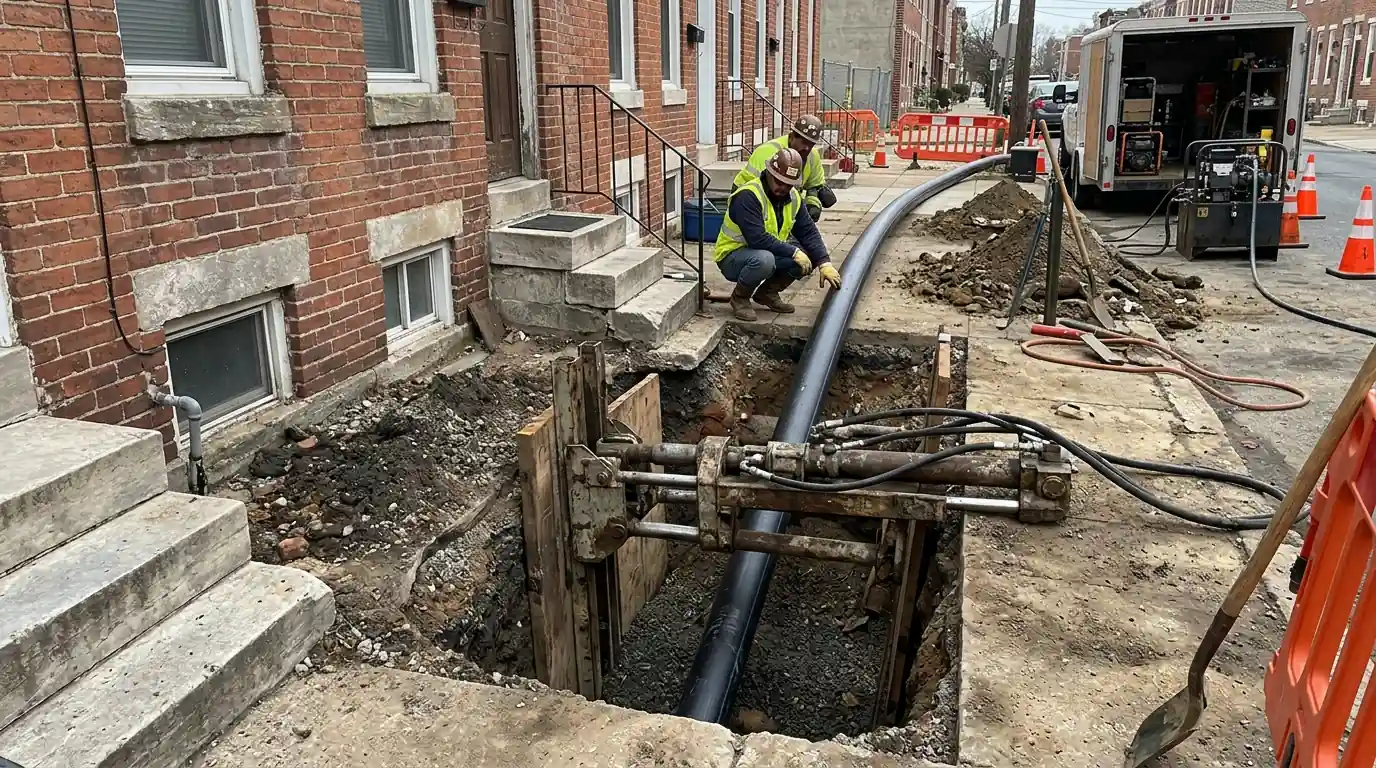
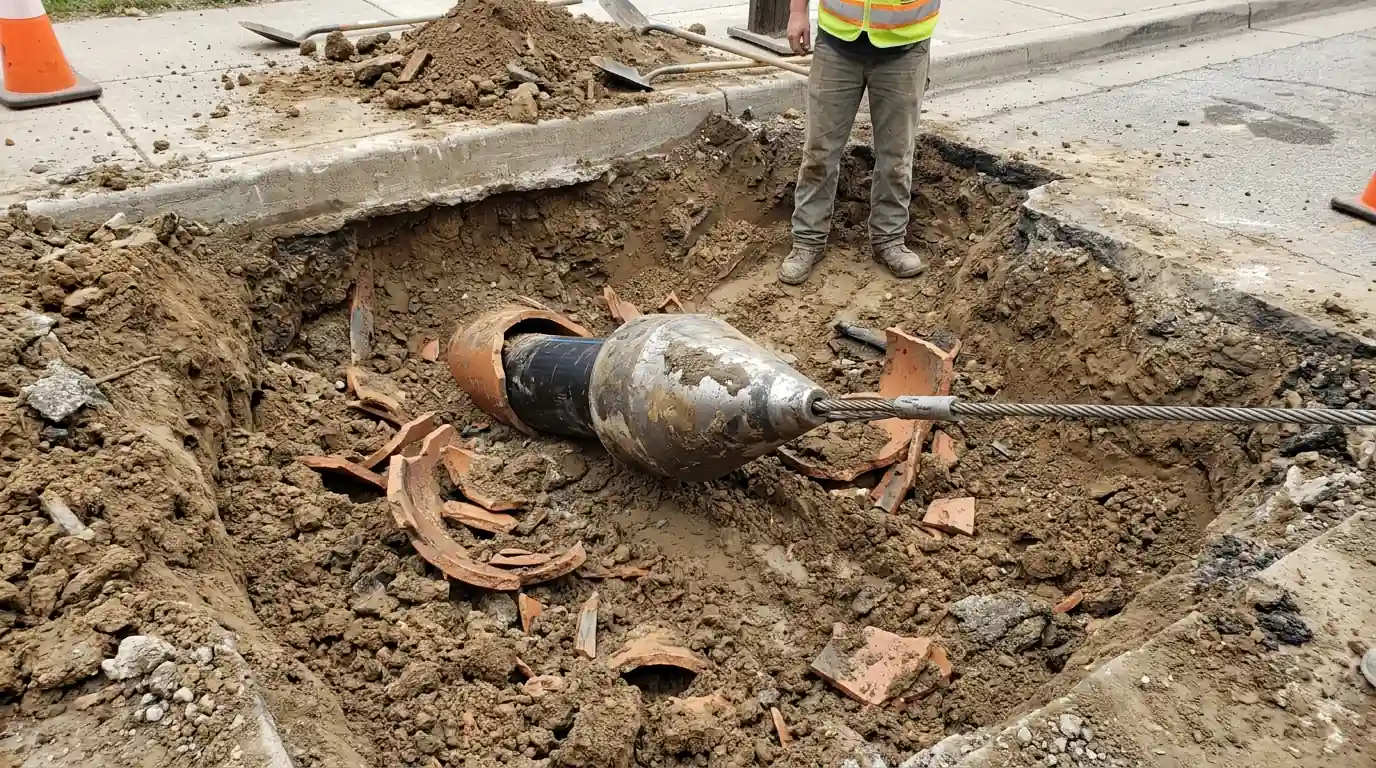
Bursting drags a cone-shaped head through the old lateral on a steel cable, splitting clay or cast iron outward into the soil while new pipe follows right behind it. It suits a line that has broken in many places but still runs on a fairly straight path, and it can install pipe the same size or larger. We dig a launch pit at the house end and a receiving pit near the main. What rules it out is a sharp bend, a gas or water line close enough to be disturbed, or soil so hard the old pipe cannot be pushed aside.
Cured-in-Place Lining
Lining feeds a resin-soaked felt tube into the cleaned lateral, inflates it against the old wall and lets it harden into a jointless pipe inside the old one. With no joints left, roots lose their way in. It suits pipe that is cracked and root-damaged but still holds its round shape. The old pipe must be jetted clean first, and any collapsed section has to be dug and repaired before the liner goes in. The trade-off is a slightly smaller opening, which most house laterals can carry without trouble.
Open Trench Replacement
Digging the whole line is the old way, and sometimes it is still the right one. A lateral that has collapsed, sags in a long belly or has to change pitch or depth cannot be fixed by pulling or lining through it. We open a trench from the house wall to the main, remove the old pipe, set new pipe on proper bedding at the right slope and backfill in compacted layers. The cost lives in what sits on top, because sidewalk, steps and landscaping all have to come up and go back down.
How a full lateral replacement is done
Camera, locate and measure
We film and mark the full run and confirm depth at the house and at the main.
Pick the method and permit it
Bursting, lining or trench is chosen from the footage, and permits are pulled where the work requires them.
Prepare the line
Pits are dug or the old pipe is jetted, depending on the method.
Install the new lateral
The new pipe is pulled, cured or laid and connected at the house and at the main.
Inspect, test and restore
Inspection, a flow test and a final camera run come before the surface is put back.
Living without the sewer during a replacement
While the old lateral is cut and the new one is not yet connected, nothing can go down any drain in the house. The taps still run, but there is no flushing, no showers and no laundry.
Lining and bursting usually keep that window shorter than open trench, because less ground is opened. We tell you when the line goes out of service before work starts, and test it before the drains are used again.
Replacement, the backup program and HELP loans
A new lateral can do more than stop clogs in Philadelphia. PWD's Basement Backup Protection Program installs backwater valves for eligible owners, but broken pipes must be fixed first, through a HELP loan or a private plumber, and the contractor has to be able to reach the plumbing where the valve goes. HELP itself is a zero-interest loan repaid over 60 months on the water bill for repairs after a Notice of Defect. If you plan to apply for a valve later, tell us, and we will keep that access in mind.
Questions about sewer line replacement in Philadelphia
When the old pipe and its path suit it, yes. Bursting and lining leave most of the sidewalk and yard alone, which saves restoration costs. When the line is collapsed or badly sagged, digging is the only fix that corrects it.
Yes, as long as the ground can be opened. Frozen ground slows a trench job more than lining or bursting.
Someone needs to let us into the basement at the start and again before we reconnect. Between those points most of the work happens outside, though the drains stay out of service.
It stops backups caused by the broken line. Water pushed back from a city sewer running full is a separate problem that a backwater valve addresses, and our backup and valve guide covers it.
Not automatically. If the trap at the front wall is cracked or missing caps, it makes sense to handle a trap repair while the line is open, and we will tell you what we see.