Updated October 2026
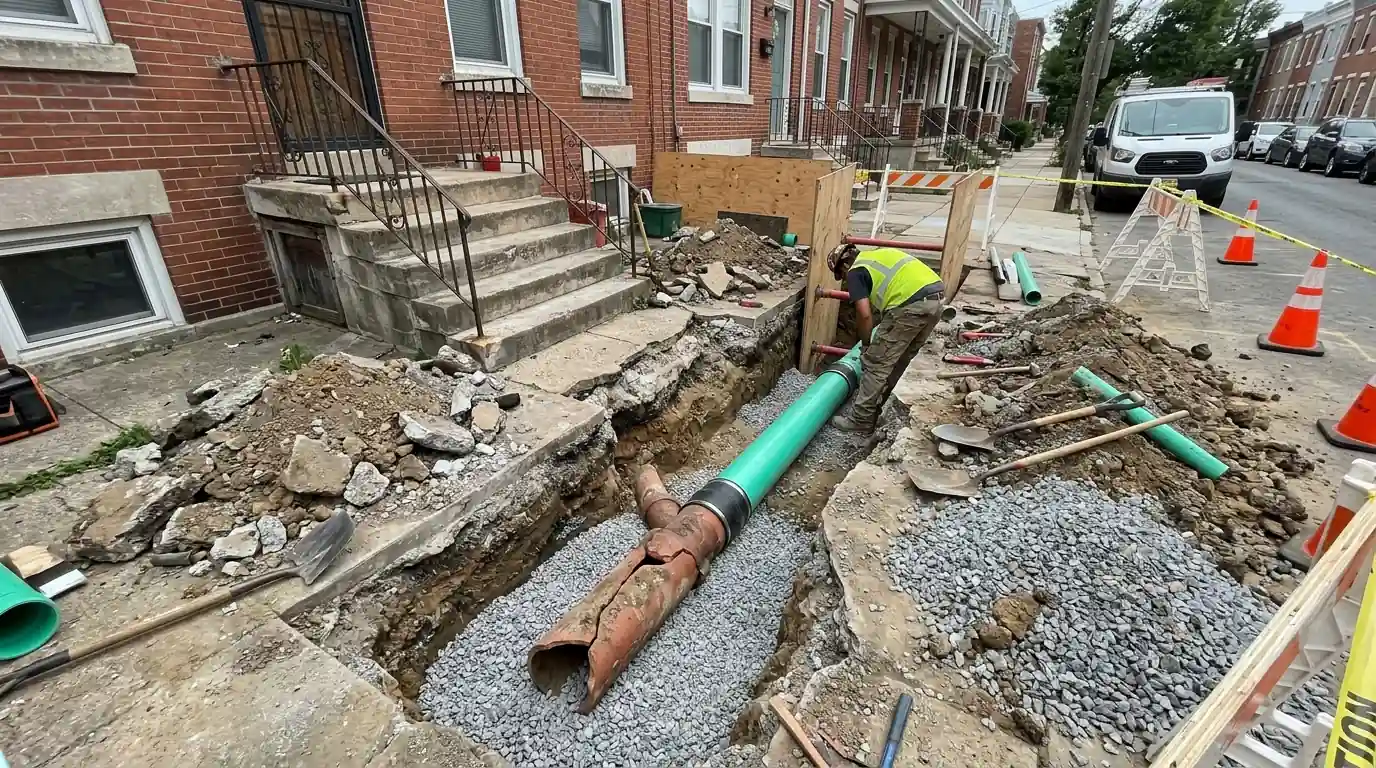
Sewer lateral repair in Philadelphia fixes the damaged part of the pipe between your house and the city main, which the owner is responsible for. Common problems are collapsed terra cotta, offset joints that let roots in, and breaks that wash soil away under the sidewalk. We locate the damage on camera, dig at that spot and replace the bad section.
What a lateral repair involves
The lateral is the private sewer pipe that runs from your front or back wall, under the sidewalk and out to the main in the street. In older Philadelphia homes it is often terra cotta or cast iron, joined every few feet, and each joint is a place for roots and settling soil to cause trouble.
Repair means replacing the damaged length, not the whole line. A camera run with a locator marks the spot and depth, we excavate there, cut out the bad section and join new pipe to the sound pipe on either side. When the footage shows defects along most of the run, we talk about replacing the whole lateral instead.
Spot repair or a new lateral?
The camera footage makes this choice for most owners. One bad joint and a whole line of bad joints are different jobs.
| What matters | Spot repair | Full replacement |
|---|---|---|
| Damage on camera | One section or a few joints | Problems along most of the run |
| Excavation | One pit at the marked spot | A trench, or pits at each end |
| Rest of the pipe | Stays in service | Replaced end to end |
| Roots later | Can return at the old joints | New pipe has no open joints |
What sets the price of a lateral repair
A lateral repair is priced mostly by how much pipe is replaced and what we have to dig through to reach it.
- Length of pipe replacedOne joint and several feet of collapsed clay are very different jobs.
- Depth of the lineDeeper pipe means a bigger excavation and shoring to keep the trench safe.
- What is on topLawn is quick to open; sidewalk, steps or a driveway add cutting and restoration.
- Private side or street sideWork that reaches into the street brings extra permits and traffic control.
- Permit and inspectionWhen the repair needs a permit, the fee and the inspection visit are part of the price.
Collapsed Terra Cotta
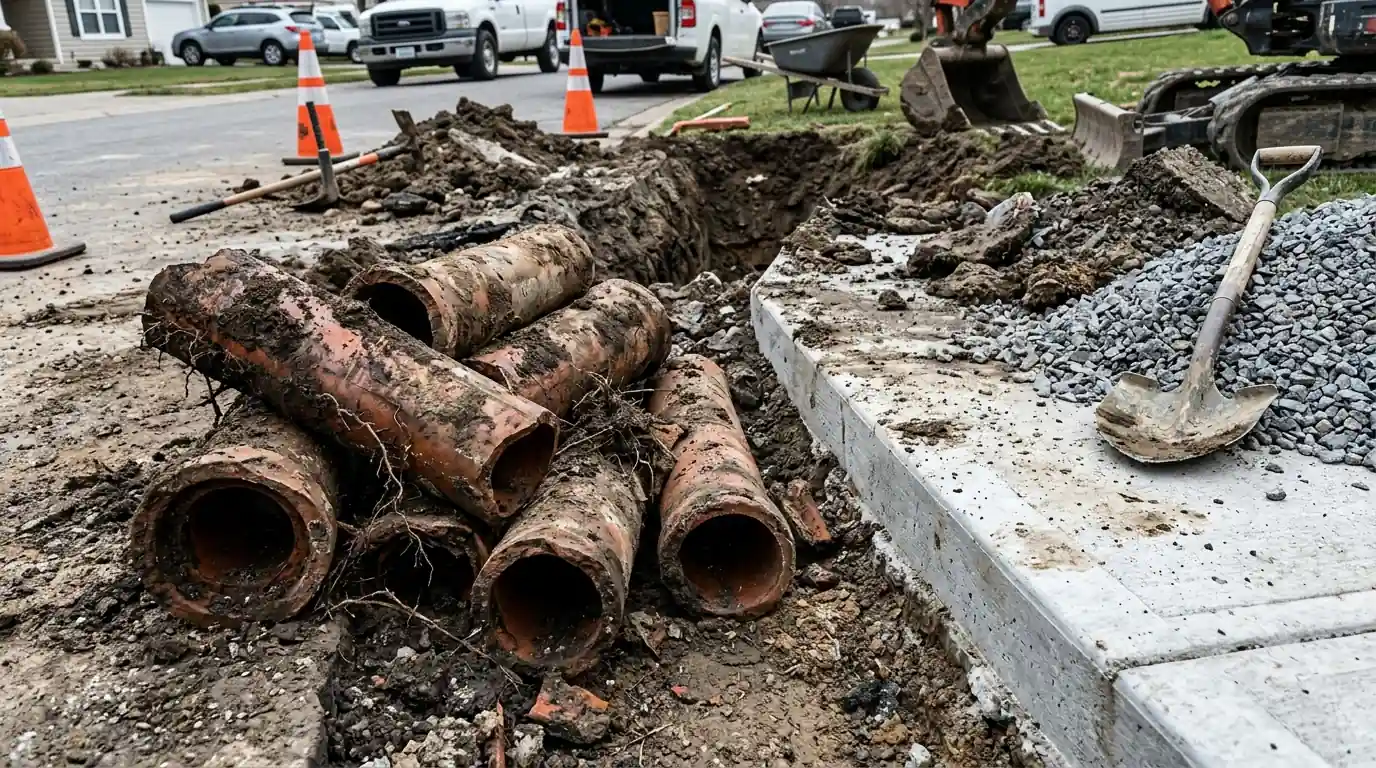
Clay pipe is strong under even pressure and brittle under point loads. Tree roots, frost and heavy traffic over a shallow line can crack a section until it falls in on itself. The owner sees a main that cannot be cleared past a certain distance, often with mud on the cable when it comes back out. We dig at the marked spot, remove the broken clay and lay new pipe on a firm, compacted bed so it does not settle again. How much we replace depends on how far the cracking runs on either side of the collapse.
Offset Joints
When soil settles or roots push between two lengths of pipe, one end drops or shifts sideways. The step it creates catches paper and wipes, and the gap invites more roots. On camera it looks like a ledge across the pipe. Owners usually know it as a line that needs cleaning on a regular schedule. A single offset close to the house can be dug out and rejoined with a shielded coupling. Several offsets along the run, or one sitting deep under the street, push the decision toward lining or replacement.
Sinking Sidewalk Over the Line
A slab that keeps dropping, a hole that opens by the curb, or a lawn that stays soft over the sewer path all point to water leaving the pipe and taking soil with it. Left alone, the void grows until the pipe loses its support and breaks further. We camera the line, mark the break from above, then cut the concrete, repair the pipe and backfill with compacted material before the surface goes back. Whether the break sits on the private side, and who restores the sidewalk, are sorted out before the dig starts.
Signs your lateral is breaking down
Backups that return after every cleaning
A line that blocks again soon after it was cleared has a defect catching debris.
Dirt or gravel in the cleanout
Soil is getting into the pipe through a break.
A sinking slab or soft lawn over the line
Water leaking from a break carries soil away with it.
Sewer smell outside the front of the house
Gas escaping from a cracked lateral can surface along its path.
Repairing a lateral step by step
Locate the damage
Camera footage and a locator mark the spot and depth at the surface.
Plan the dig
We check for buried utilities and pull the permit when the work calls for one.
Excavate and expose
The pit is opened at the mark and the pipe uncovered on both sides of the damage.
Replace the section
Bad pipe comes out and new pipe is joined to sound pipe with proper couplings and bedding.
Test, film and backfill
We run water and camera the repair, then compact the trench and put the surface back.
Lateral repairs and help for Philadelphia owners
Philadelphia puts the sewer lateral on the property owner, from the house all the way to the main in the street, so a break under the sidewalk is a private repair. When PWD issues a Notice of Defect, its Homeowner's Emergency Loan Program, known as HELP, offers a zero-interest loan for the repair, paid back over 60 months on the water bill. If you have received a notice, bring it to the first visit and we will work from what it describes.
Questions about sewer lateral repair in Philadelphia
The property owner. The lateral from the house to the city main is private pipe, even the part under the sidewalk. Our guide to lateral ownership explains where the line ends.
Some damage can be lined from inside, which avoids a trench. A full collapse or a badly offset joint usually has to be dug, because a liner needs a continuous pipe to form inside.
The camera tells us how far along the pipe the damage is, and a locator finds that spot and its depth from above. We dig there, not along the whole line.
Not through the new section. They can still find older joints elsewhere on the line, which is why we show you the full footage before choosing a repair.
It is a notice from PWD telling an owner that a defect in their plumbing needs repair. Owners who receive one may be eligible for the HELP loan, which is zero-interest and repaid on the water bill.