Updated October 2026
Most pipe leaks in Philadelphia homes come from pinholes in old copper, weeping drain joints and corroded galvanized fittings. A clamp may stop the drip for a while, but the lasting repair cuts out the bad section and joins new pipe to sound material. If the pipe on either side is thin or rusted, that is a sign a longer replacement is coming.
Fixing the leak and the pipe around it
A leak is a symptom. In old copper, a pinhole usually means the wall is thin in other spots too. In galvanized steel, the threads rust from the inside until a fitting weeps. In a drain, a joint opens because the pipe settled or a slip nut was never tight. Before we repair anything, we look at the pipe on both sides.
Then we repair to good material: new copper soldered or pressed in, rusted nipples swapped for brass or copper with a proper transition, drain joints remade with new washers or fittings. If we keep finding thin walls and rust, we say so, because paying for leak after leak usually costs more than replacing the run. When you cannot see where it is coming from, leak detection comes first.
Pinhole Leaks in Copper
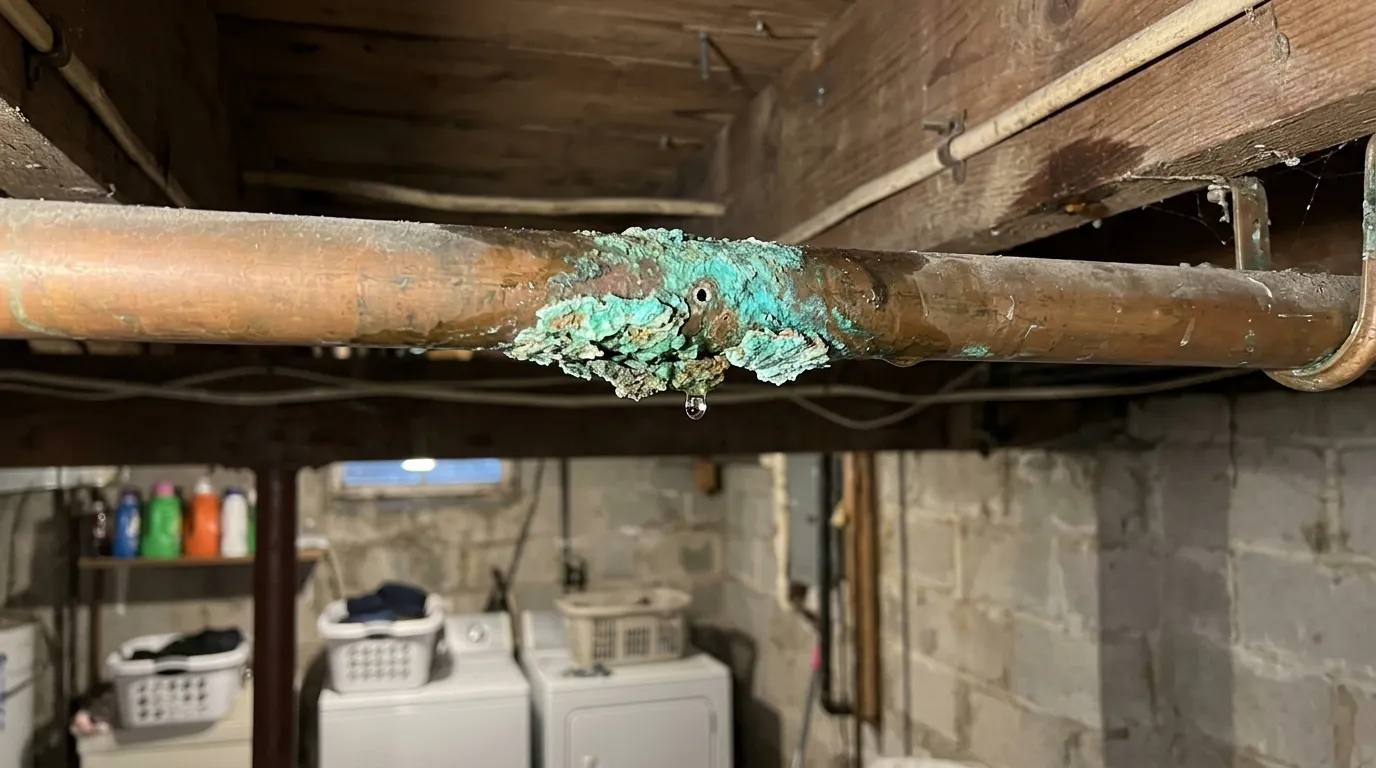
Pinholes start as a green or blue crust on the outside of a copper pipe, then become a slow drip or a fine mist that soaks the insulation around it. They form where the inside wall has worn thin from water chemistry, high flow or poor soldering years ago. We shut the line, cut out a short length and solder or press in new pipe. If there is more crust along the run, or this is the third pinhole on the same line, replacing that run makes more sense than chasing holes one at a time.
Leaking Drain Joints
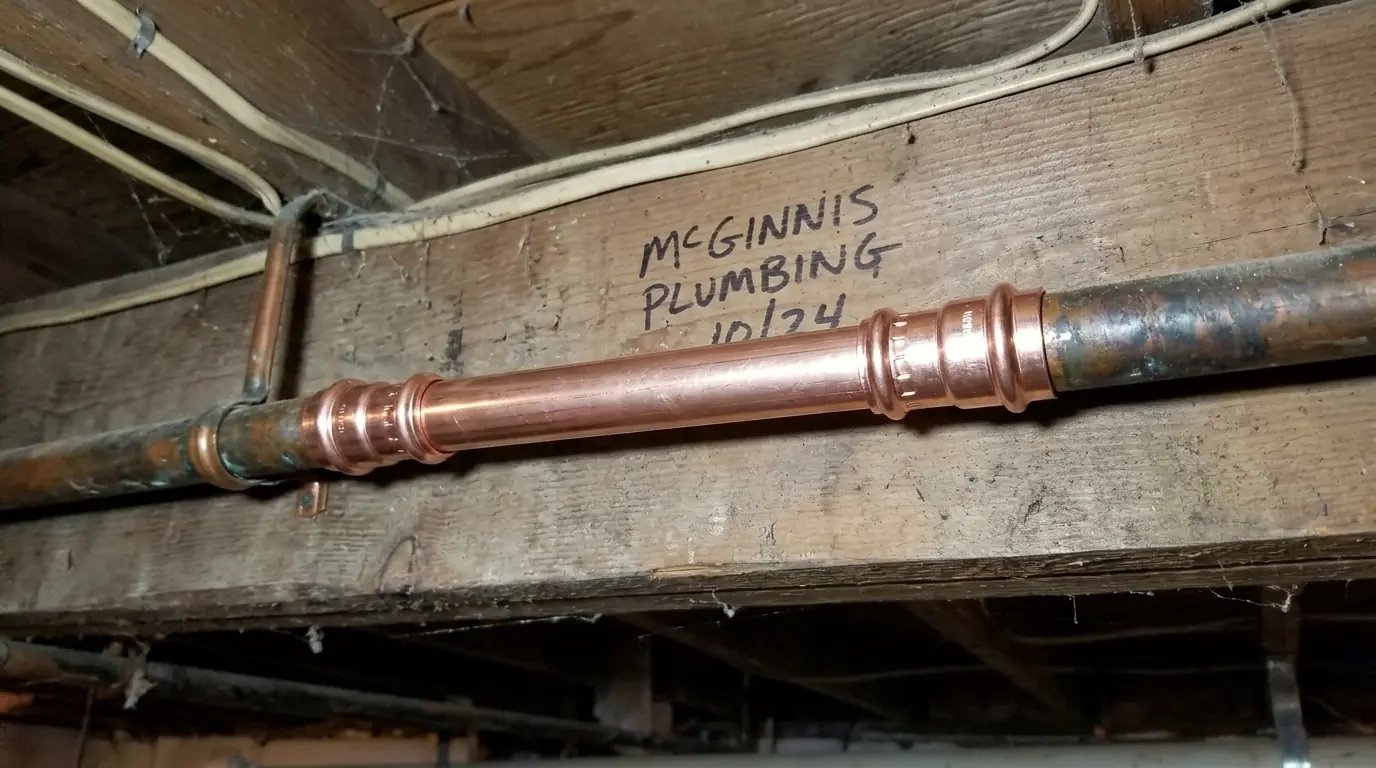
Drain leaks only show when water runs, so the first sign is often a damp spot under the sink after the dishwasher empties, or a drip on the basement floor after someone showers upstairs. The cause is usually a loose slip nut, a worn washer, a cracked plastic fitting, or a cast iron hub where the old lead and oakum seal has dried out. We tighten or rebuild plastic joints, and on cast iron we cut out the failed hub and join new pipe with shielded couplings. If the iron around it is flaking and soft, a stack replacement is worth discussing.
Corroded Galvanized Nipples
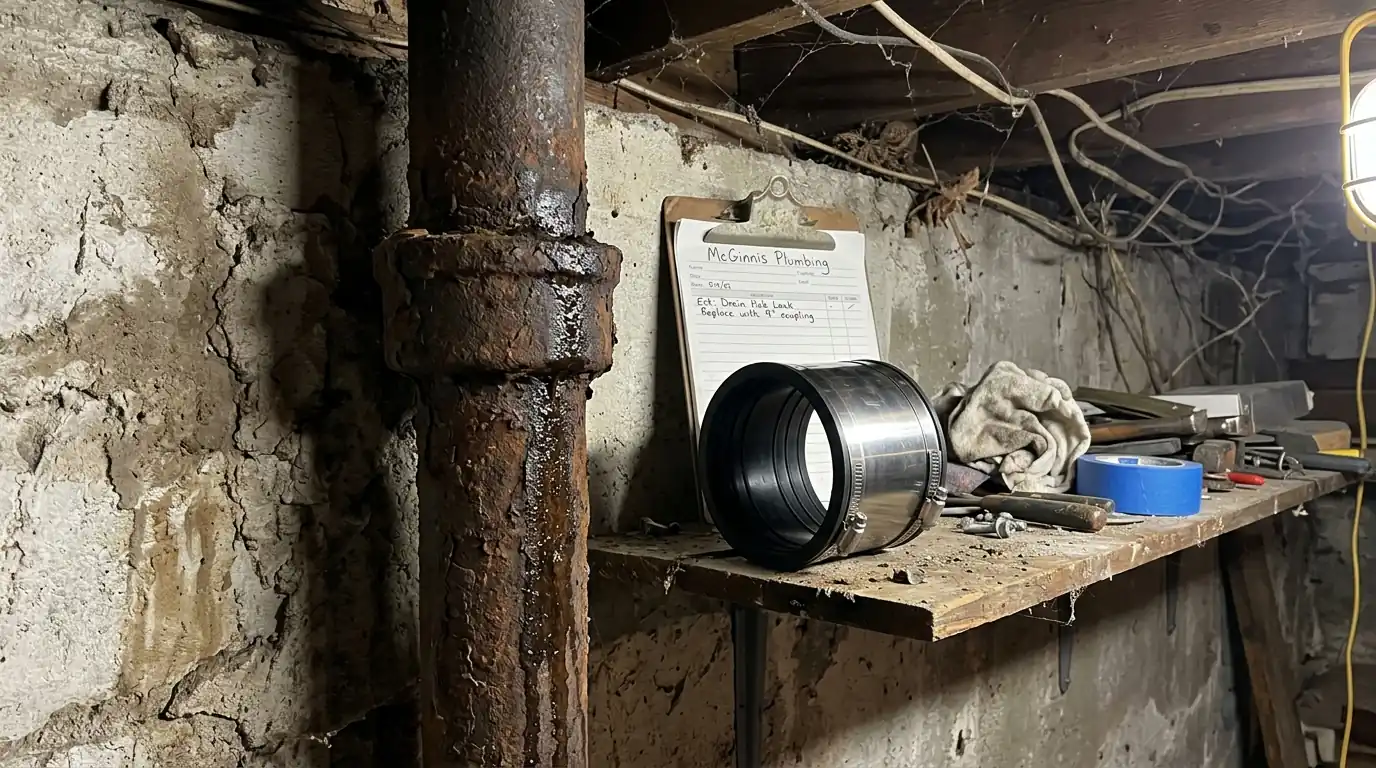
Galvanized steel rusts from the inside, and the threaded ends, where the pipe wall is thinnest, go first. You see rust stains, a weep at a fitting near the water heater, or a short nipple dripping at every connection. Twisting old galvanized often breaks it further back inside the wall, so we hold the pipe, cut back to sound threads or the next fitting, and transition to copper or PEX with a dielectric union. Several weeping fittings mean the rest of the galvanized is not far behind.
How we repair a leaking pipe
Confirm the source
Water travels along pipe and framing, so we trace it back to where it starts.
Shut and drain the section
The branch or main is closed and drained so the repair stays dry.
Cut back to good pipe
Damaged or corroded pipe is removed until solid material is reached on both sides.
Join new pipe
Solder, press, crimp or shielded couplings, matched to the material.
Test and check nearby joints
Water returns under pressure and we look over the neighboring fittings for weeps.
Leaks in an older Philadelphia housing stock
Philadelphia's houses are old, and the pipes inside them often carry decades of patchwork. Units built in 1939 or earlier make up 41 percent of the housing in Philadelphia County, and only 15 percent have gone up since 1980. That age shows up as galvanized nipples rusting through at the threads, cast iron hubs drying out, and copper spliced in by different hands at different times. We repair the leak in front of us and tell you honestly what the pipe beside it looks like.
Why one leak costs more than another
The repair itself is often a small piece of pipe. Reaching it and making it hold on old material is what drives the cost.
- Pipe materialCopper and plastic join easily; galvanized and cast iron take more cutting and transition fittings.
- AccessExposed basement pipe is quick to reach; pipe behind tile or in a finished ceiling is not.
- Condition beyond the leakThin or rusted pipe nearby means replacing a longer length.
- Supply or drainSupply repairs need the water shut off; drain repairs need fixtures above left unused.
- Number of leaksSeveral weak spots on one run may point to replacing the run instead.
Clamp, new section or repipe
Every leak gets one of three fixes. Which one makes sense depends on the pipe around the leak, not just the leak itself.
| Fix | When it fits | Trade-off |
|---|---|---|
| Repair clamp | A stopgap until a planned repair | Not a permanent fix on a supply line |
| Section replacement | One leak in otherwise sound pipe | Pipe on both sides must be in good shape |
| Partial or full repipe | Repeated pinholes or badly rusted galvanized | More work now, far fewer leaks later |
Owner fixes and plumber fixes
Some small leaks are fair game for a handy owner. Others turn a drip into a flood when they go wrong.
| Task | Safe to do yourself | Call a plumber |
|---|---|---|
| Tighten a slip nut on a sink trap | Yes. Hand tight plus a quarter turn. | If the trap is cracked or the washer is missing. |
| Put a repair clamp on a pinhole | Yes, as a stopgap until the repair. | Every time. Clamps on supply lines are temporary. |
| Put a wrench on old galvanized | No. Twisting it often snaps the pipe inside the wall. | Always. We support the pipe and cut back to sound threads. |
Questions about pipe leak repair in Philadelphia
It is a warning. The crust forms where moisture escapes through a pinhole or a bad joint. Even if it is dry today, that spot should be cut out before it starts dripping.
Not properly. A clamp can slow it, but a lasting repair needs the line shut and drained.
Drain leaks only run when a fixture above is used. Running each fixture one at a time shows which joint is leaking.
If one fitting is leaking, others are usually close. A partial or whole house repipe often costs less than a string of emergency repairs.
We do not use them. They can clog aerators, valves and water heater parts, and they do nothing about the thinning pipe that caused the leak.