Sewer lateral and drain repair in Fox Chase, Philadelphia
Drains keep backing up even after they were snaked? In Fox Chase we look past the clog to the sewer lateral, the pipe you own from the house to the main, and fix the break, sag or root intrusion that keeps causing it.
- Camera footage of the line before any digging is planned
- Spot repairs where one section failed, full replacement when the pipe is gone
What causes repeat drain backups in Fox Chase?
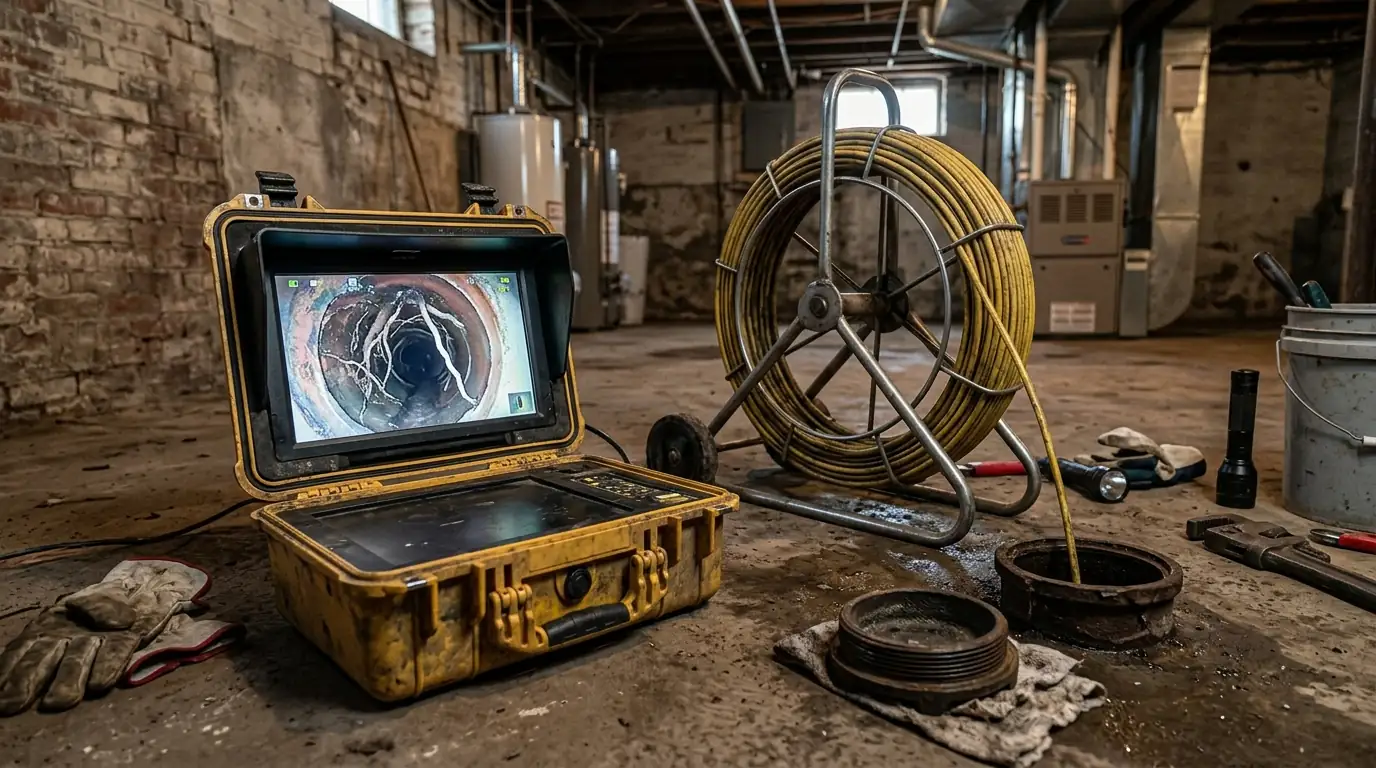
In Fox Chase, a drain that backs up again weeks after cleaning usually has a problem in the sewer lateral, not the fixture. Roots through joints, a cracked section or a sag that holds water all catch waste over and over. A camera inspection shows which one it is, and the repair is planned from that footage instead of guesswork.
Fox Chase sits on the Montgomery County line, next to Rockledge and Cheltenham Township. Huntingdon Pike, the road our office is on, runs south through Rockledge to the city line at Fox Chase, so this is one of the closest parts of the city to us.
Sewer work is the bulk of what brings us here. A slow basement drain gets snaked, it runs fine for a month, then the same floor drain fills again. That pattern means the cable punched a path through something that is still there. We run a camera down the line, mark the depth and location of the defect from the surface, and show you the footage before choosing between a spot repair and a full lateral replacement.
Who owns the lateral, and what a Northeast study found
In Philadelphia the property owner, not the city, is responsible for the sewer lateral that runs from the house to the main in the street, along with the water service line. A break under the sidewalk or in the roadway is still the owner's to repair, which is why knowing exactly where the defect sits matters before anyone digs.
A Philadelphia Water Department investigation of two Northeast Philadelphia blocks found lateral or vent problems at 48 of the 80 homes it examined. Each of those homes had two laterals and two vents, one set for the storm sewer and one for the sanitary sewer. No study can say how a particular block compares, but those numbers are a good reason to camera a line that keeps acting up rather than cleaning it again and hoping.
Plumbing jobs we handle in Fox Chase
Fox Chase calls tend to start at a drain and end up at the sewer. These are the jobs we do along the way.
Sewer Lateral Repair
A single cracked or offset joint can be dug out and replaced without tearing up the whole run.
Sewer Camera Inspection
Footage shows roots, bellies and breaks, and the locator gives us the depth before anyone picks up a shovel.
Main Sewer Line Cleaning
A root mass at a joint stops the whole house, and cutting it out restores flow while a repair is planned.
House Trap Repair
The trap at the front wall can block on its own, so we rule it out before blaming the lateral.
Sewer Line Replacement
Clay or cast iron that has collapsed in more than one place is usually cheaper to replace than to patch section by section.
Drain Cleaning
Some backups really are a clogged branch line, and a kitchen or tub drain clears without touching the sewer.
The property owner. The lateral belongs to the house all the way to the main in the street, so a break under the sidewalk or curb is the owner's repair. Our guide to lateral ownership covers where the city's responsibility begins.
Not always. Roots get in through joints that have opened, and cutting them out restores flow. If the camera shows the pipe is still round and sound, a spot repair at the bad joint may be enough; roots returning at several joints point toward replacement.
Yes. The camera head carries a transmitter, and a locator above ground marks its position and depth. That lets us dig one hole in the right place instead of trenching to find the problem.
We excavate down to the damaged section, cut out the broken pipe and join new pipe to sound pipe on each side with shielded couplings. The trench is backfilled once the line passes a flow test. Restoring concrete or pavers is discussed before the dig starts.
A dry floor drain trap, a missing cleanout cap or a cracked vent can let sewer gas in. Pour water into drains that rarely get used. If the smell stays, the vent or the house trap needs a look.
Same drain backing up again?
Book a camera inspection and see the line for yourself. If the basement is filling right now, we clear it first and scope it once it drains.