Updated October 2026
Burst pipes in Philadelphia mostly come from freezing, old fittings giving up, or pressure spikes on a weak spot. The fix is to shut the water, open the wall or ceiling enough to reach sound pipe on both sides, cut out the damaged length and join in new pipe. The line is then tested under pressure and checked for a second split nearby.
Clues a pipe has burst out of sight
Sudden drop in pressure
Every faucet goes weak at once because water is escaping between the meter and the fixtures.
Hissing with everything shut off
A steady rushing sound in a wall or ceiling is the line feeding a split.
A ceiling that sags or drips through a light
Water pools above plaster or drywall before it finds a way through.
Meter moving with no taps open
The dial or leak indicator keeps turning even though nothing is using water.
Why pipes split and what a lasting repair looks like
Water expands as it freezes, and pressure builds between the ice plug and a closed faucet until the weakest spot gives. That is why a split often turns up a few feet from where the pipe actually froze, and why it starts leaking only after the ice melts. Old fittings, thin pipe walls and pressure spikes from a failed regulator account for most of the rest.
A lasting repair replaces the damaged length, not just the visible crack. We open enough of the wall to reach clean, round pipe on both sides, then sweat in copper or crimp in PEX. If the line froze, we also deal with why, because the same pipe will split again next winter unless it is insulated or moved off the cold wall, which is part of every frozen pipe call we run.
Freeze-Split Copper
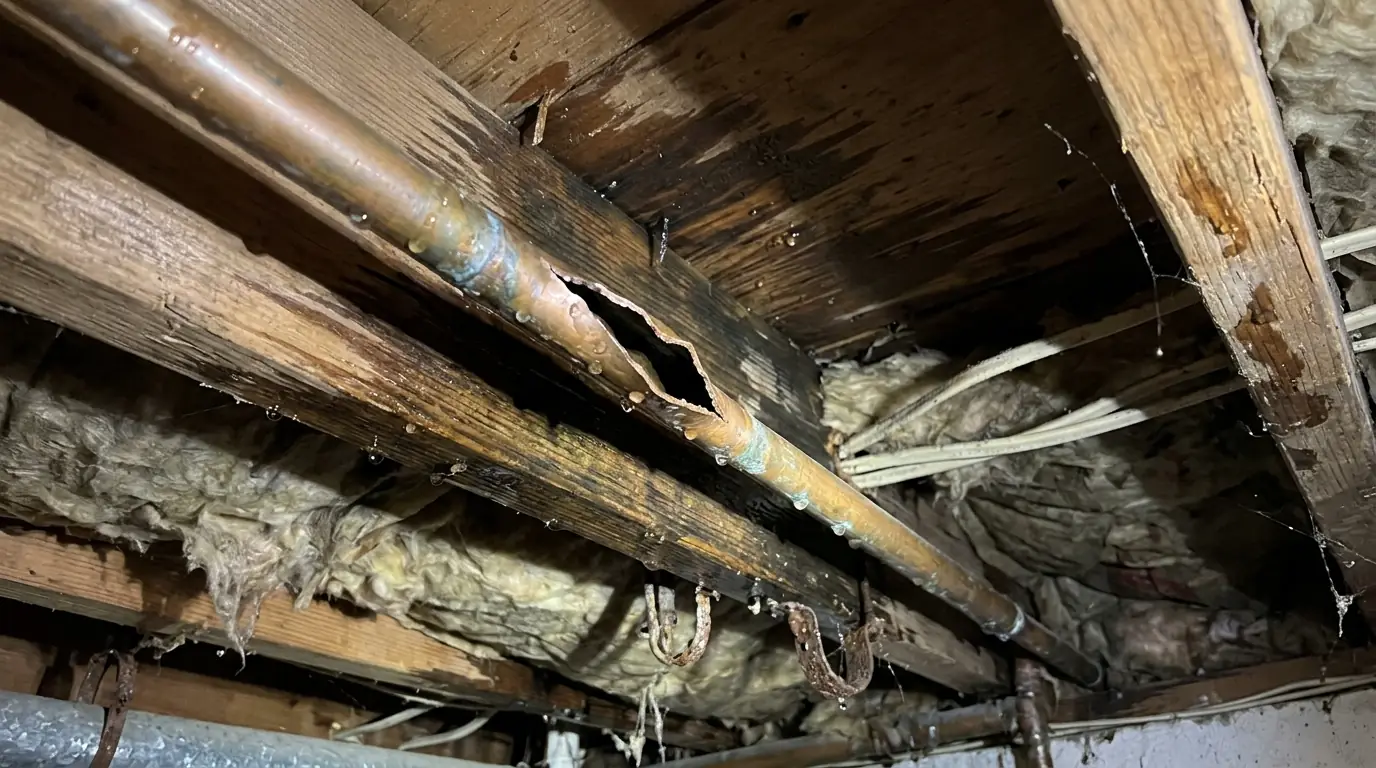
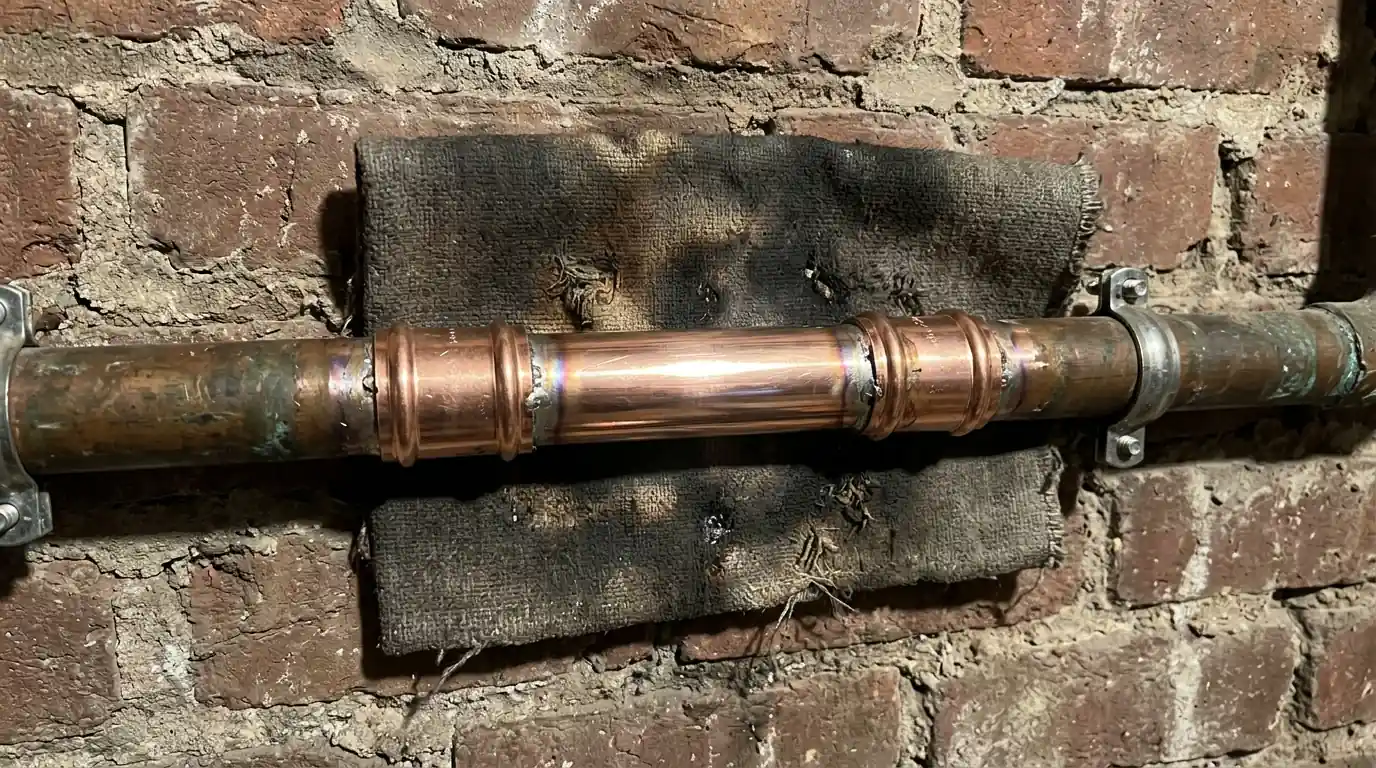
Frozen copper usually opens along its length in a thin seam, and it rarely shows until the line thaws and water sprays out. The pipe often bulges past the visible split too, so we cut back until the copper is round again and solder in a new section, or use press fittings where an open flame would be a risk near dry framing. What decides the approach is how far the bulge runs and where the line sits. If it lives in an outside wall, moving it inside the insulation is the better fix.
Blown Compression Fittings
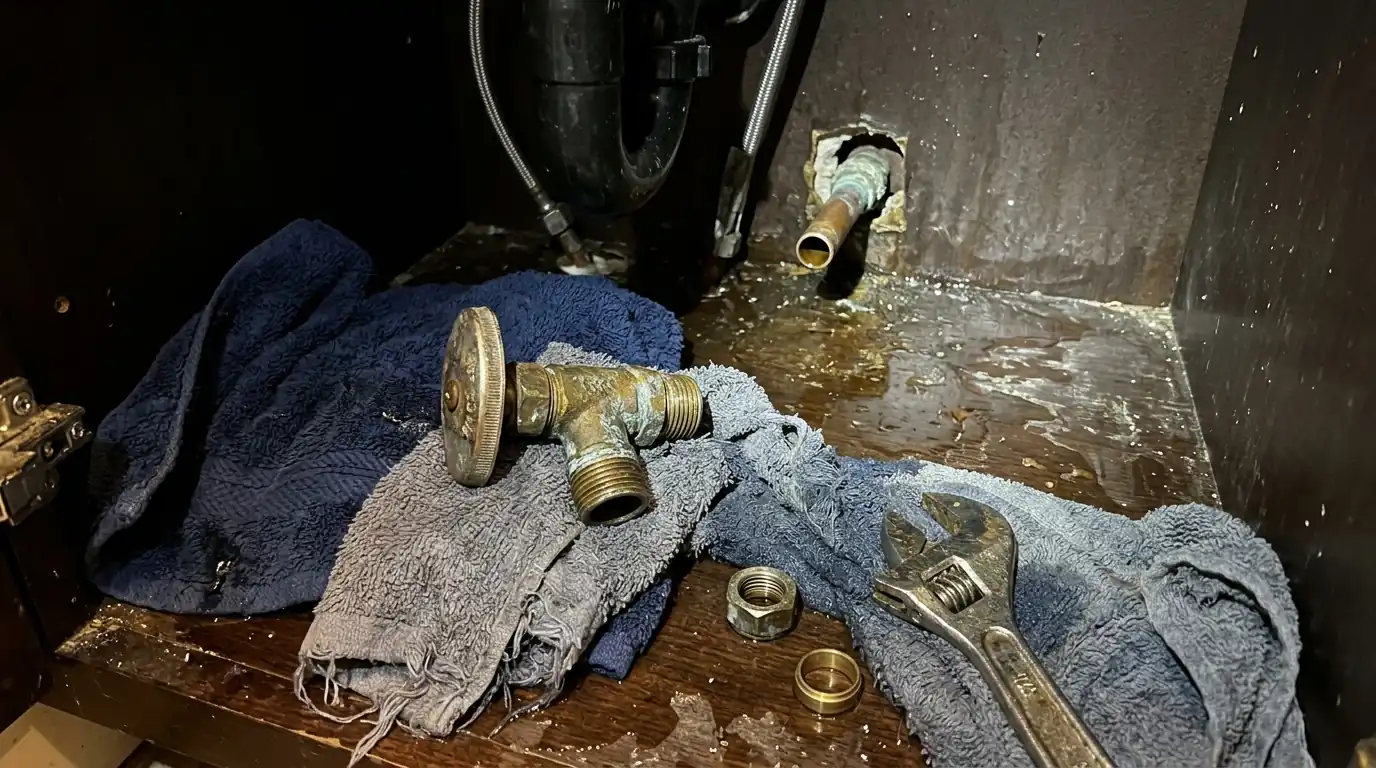
Compression fittings on stop valves, water heater connections and old repairs rely on a brass ferrule squeezed onto the pipe. Over the years the nut loosens, the ferrule slips or the pipe end corrodes, and a fitting that wept quietly for months finally pushes off under pressure. You find it as a sudden spray under a sink or behind a toilet. We trim back to fresh pipe and fit a new stop and connection so the ferrule seats on a clean surface. If the stub is too short or pitted, a sweat or press fitting replaces the compression joint.
Ceiling Pipe Bursts
When a pipe bursts above a ceiling, the first sign is a brown stain, a bulge in the plaster or water dripping out of a light. Shut the main and the breaker for that circuit. We open the ceiling from below at the wettest point, which is near the break but not always directly under it, and cut an access hole sized for the repair. Once the pipe is replaced and tested, we leave the opening clear so the cavity can dry out before anyone patches it.
How long you will be without water
The water is off from the moment we close the main until the new section is joined and tested. When the burst sits on a branch with its own valve, we isolate that branch and give the rest of the house its water back while we work.
If several splits turn up along one frozen run, or the main valve is too seized to hold, the repair takes longer. We tell you what we found before we start so you can plan around it.
From shutoff to pressure test
Shut and drain
We close the main, open a low faucet and relieve pressure so the repair area stays dry.
Open up to sound pipe
The wall or ceiling is opened only as far as needed to reach good pipe on both sides.
Cut out and replace
The split length comes out and new copper or PEX goes in with proper fittings and support.
Pressure test
Water returns slowly while we watch the repair and the nearby joints for weeping.
Find the cause
We look for other frozen sections, high pressure or weak fittings that could fail the same way.
Burst pipes after a Philadelphia cold snap
Most burst pipes we see in Philadelphia follow a hard freeze. Pipes face a greater risk of freezing and bursting once temperatures stay below 32 degrees for more than 72 hours, especially when water sits still in the line overnight. The age of the housing adds to it. Just over 40 percent of Philadelphia homes were built before 1940, and many of their supply lines run through unheated back additions, crawlspaces and outside walls that were never insulated.
What decides the cost of a burst pipe repair
The pipe itself is rarely the expensive part. Reaching it, and making sure no second split is hiding nearby, takes most of the time.
- AccessA break in an open basement ceiling is quick to reach; one behind tile or a finished ceiling needs careful opening.
- Length of damageFrozen copper can be bulged well past the visible split, so a longer piece may have to come out.
- Pipe materialCopper, PEX, CPVC and galvanized each take different fittings and tools.
- Number of breaksA long frozen run sometimes splits in more than one place.
- ReroutingMoving a line off a cold outside wall adds work but stops a repeat.
Questions about burst pipe repair in Philadelphia
Repair tape or a clamp can slow a pinhole, but it will not hold a real split under full pressure. Shut the water off instead and leave it off until the pipe is replaced.
The split forms while the pipe is frozen, but the ice plugs the gap. When the ice melts, water pours out of a crack that was already there.
For a short repair either works. PEX tolerates freezing better than copper, so it suits lines near cold walls.
We open and close access as cleanly as we can, but finished plaster and drywall work is a separate trade. Letting the cavity dry before patching also keeps mold from starting behind it.
Insulate pipes in outside walls and crawlspaces, let a faucet drip on very cold nights and keep sink cabinets on outside walls open. Our frozen pipe guide covers the rest.