Updated October 2026
A garbage disposal in Philadelphia that hums without spinning is almost always jammed, and that is usually fixable without a new unit. One that makes no sound has tripped its reset or lost power. Water dripping from the body itself means the internal seals have failed, and that unit needs replacing. Leaks at the top or side connections can be repaired.
Signs your disposal needs attention
Humming with no grinding
The flywheel is stuck on something hard, such as a bone, a pit or a bottle cap.
Silence when switched on
The overload reset on the bottom has tripped, or the outlet or switch has no power.
Water dripping from the bottom
Internal seals have failed and the housing is leaking; the unit is finished.
A slow disposal side of the sink
Ground food and grease are packed in the trap or the drain beyond it.
What goes wrong under the sink
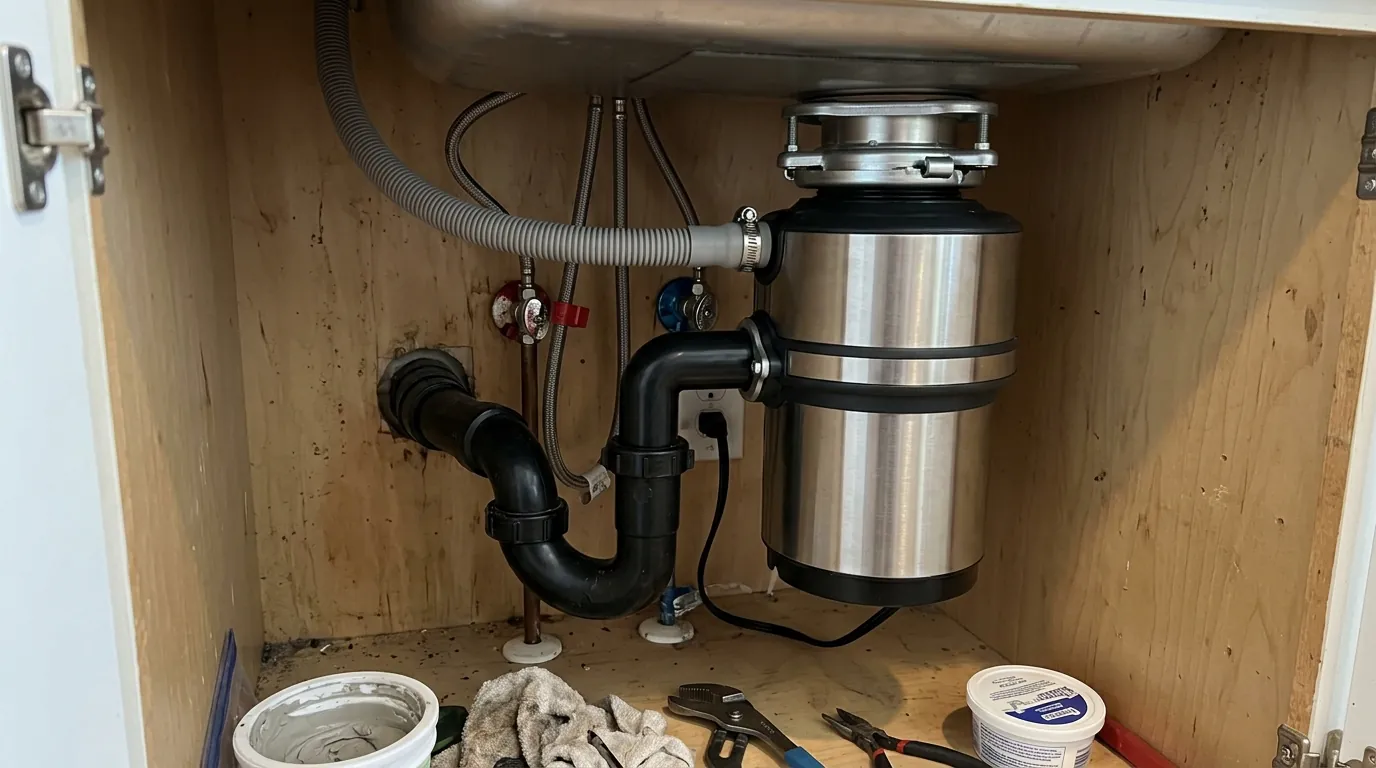
A disposal is a motor under a grinding chamber, hung from the sink on a mounting ring and tied to the drain with a discharge tube. Jams, seal leaks and drain clogs make up most calls. A true motor failure is less common, and it is usually the point where repair stops making sense.
We repair and replace InSinkErator, Waste King and Moen units among others, and size a replacement to how the kitchen is actually used. When the disposal spins freely but the sink still backs up, the problem is in the drain, and a kitchen line cleaning is the next step.
Humming but Not Turning
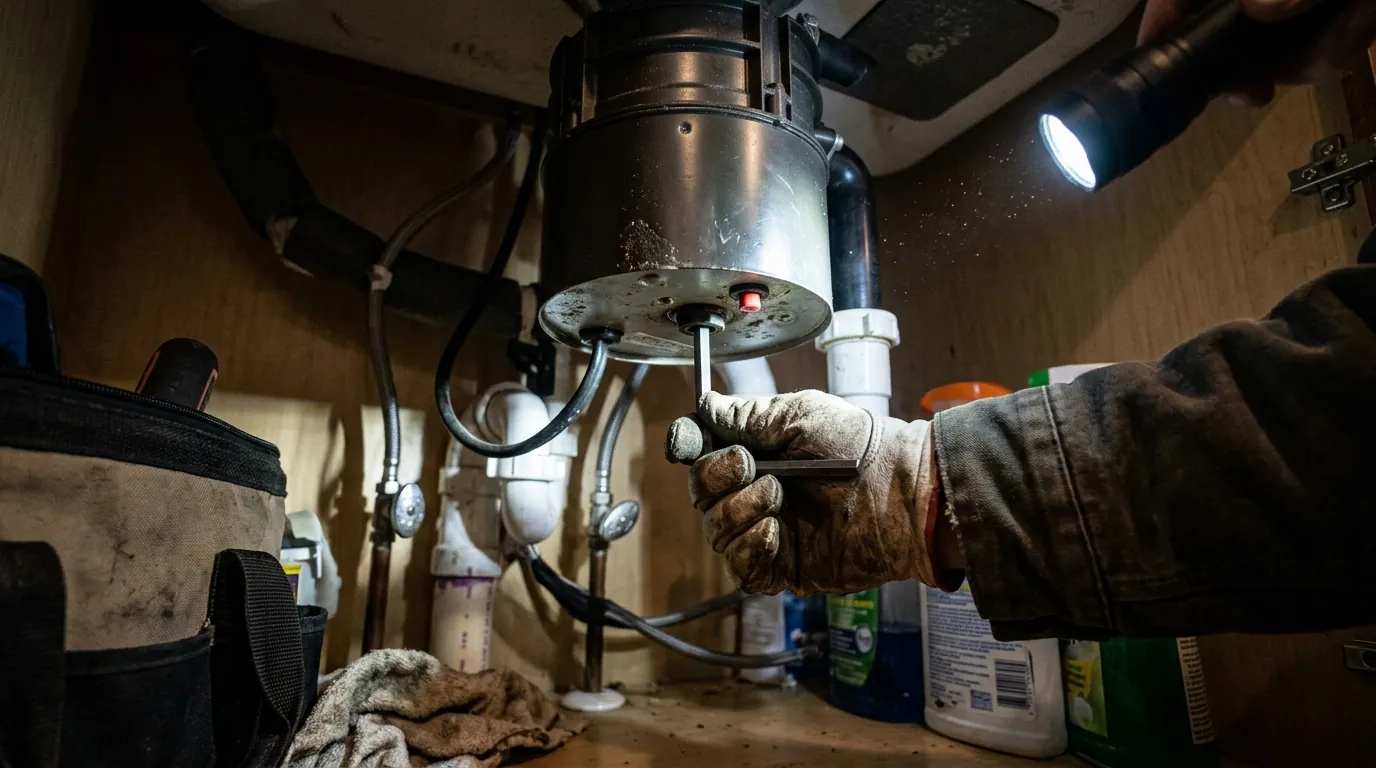
A hum with no grind means the motor is getting power but the flywheel cannot turn. Common culprits are fruit pits, bones, glass, coins and the odd twist tie wrapped around the impellers. We cut the power first, then turn the flywheel from below with a hex key in the center socket, working it back and forth until it frees. Whatever jammed it comes out through the sink opening with pliers, never fingers. After pressing the reset we run water and test. A disposal that jams again right away may have a broken impeller or a worn bearing, and that steers the conversation toward replacement.
Leaks from the Unit
Where the water appears tells us what is wrong. A drip at the top means the putty under the sink flange has dried out or the mounting ring has worked loose. A leak at the side usually comes from the dishwasher inlet or the discharge tube gasket. Water from the bottom of the housing means the internal seal has failed, which cannot be repaired. Top and side leaks are fixed by remounting the flange, replacing gaskets or tightening the discharge connection. We also check the trap and tailpiece below, since they drip onto the same cabinet floor.
Disposal Replacement
When the housing leaks, the motor will not start after a reset, or the grinding has turned into rattling, replacement is the sensible fix. We disconnect power, drop the old unit, remove its mounting assembly and seat a new flange in fresh putty. If the new disposal uses the same mount, it can twist onto the existing ring. A busy kitchen does better with a stronger motor; a light-use household does not need one. Where there is a dishwasher, we knock out the inlet plug on the new unit before connecting the hose, then test the switch and cord.
How we handle a disposal call
Cut power
Switch off and unplugged, or the circuit off when the unit is hard-wired.
Free the flywheel
Hex key from below, debris removed from the chamber, reset pressed.
Find any leak
Paper towels at the flange, discharge and dishwasher inlet show where water escapes.
Repair or replace
Gaskets and flange reseated, or a new unit mounted and connected to the existing cord or switch.
Grind and drain test
Cold water and a full grind cycle, then a check that the trap and drain carry it away.
Where disposal waste goes in Philadelphia
About 60 percent of Philadelphia is served by combined sewers, where sewage and stormwater travel in one pipe. Everything that leaves your disposal joins that flow, but first it has to get through your kitchen drain and your lateral, and in Philadelphia the property owner is responsible for the sewer laterals that connect the house to the main in the street. Grease and coffee grounds that settle in the kitchen line or the lateral are the owner's to clear, so we would rather keep them out of the drain from the start.
What drives a disposal repair price
The first question is whether the unit can be saved. A jam or loose flange is a repair; a leaking housing is a replacement.
- Jam or failed partFreeing a jam is a short visit. A seal or motor failure means a new unit.
- Same mount or new mountA replacement that fits the old mounting ring goes in faster than a new flange.
- Dishwasher connectionA shared drain adds a hose connection and sometimes an air gap or high loop.
- Drain conditionGrease packed in the trap or line beyond may need clearing before the new unit drains well.
Disposal fixes owners can do safely
Two of the most common disposal problems are safe to solve yourself, provided the power is off.
| Task | Safe to do yourself | Call a plumber |
|---|---|---|
| Press the red reset button underneath | Yes. Let the motor cool first. | If it trips again right away. |
| Turn the flywheel with the hex key | Yes, with the switch off and the unit unplugged. | If it will not budge, or frees and jams again. |
| Reach into the grinding chamber | No. Use tongs or pliers, never a hand. | If something is stuck that tools cannot reach. |
| Pour drain chemicals into the disposal | No. They attack seals and can splash back. | If the sink will not drain. |
Questions about garbage disposal repair in Philadelphia
Grease, fat, coffee grounds, fibrous peels like celery and corn husks, bones and pits.
We still say no. Use tongs or long pliers, since the chamber edges and whatever caused the jam can cut.
Food gets trapped under the rubber splash guard and on the chamber walls. Run cold water with ice and a little dish soap, and scrub the underside of the guard. A smell that lingers can also come from a slow trap.
Yes. Ground food and grease can settle in older drain lines with little slope. If the kitchen drain backs up into the other bowl, the clog is past the disposal.
No. They often share a drain, but either works without the other. When you have both, the dishwasher hose goes to the disposal inlet with a high loop or air gap, as our appliance hookup page explains.