Updated October 2026
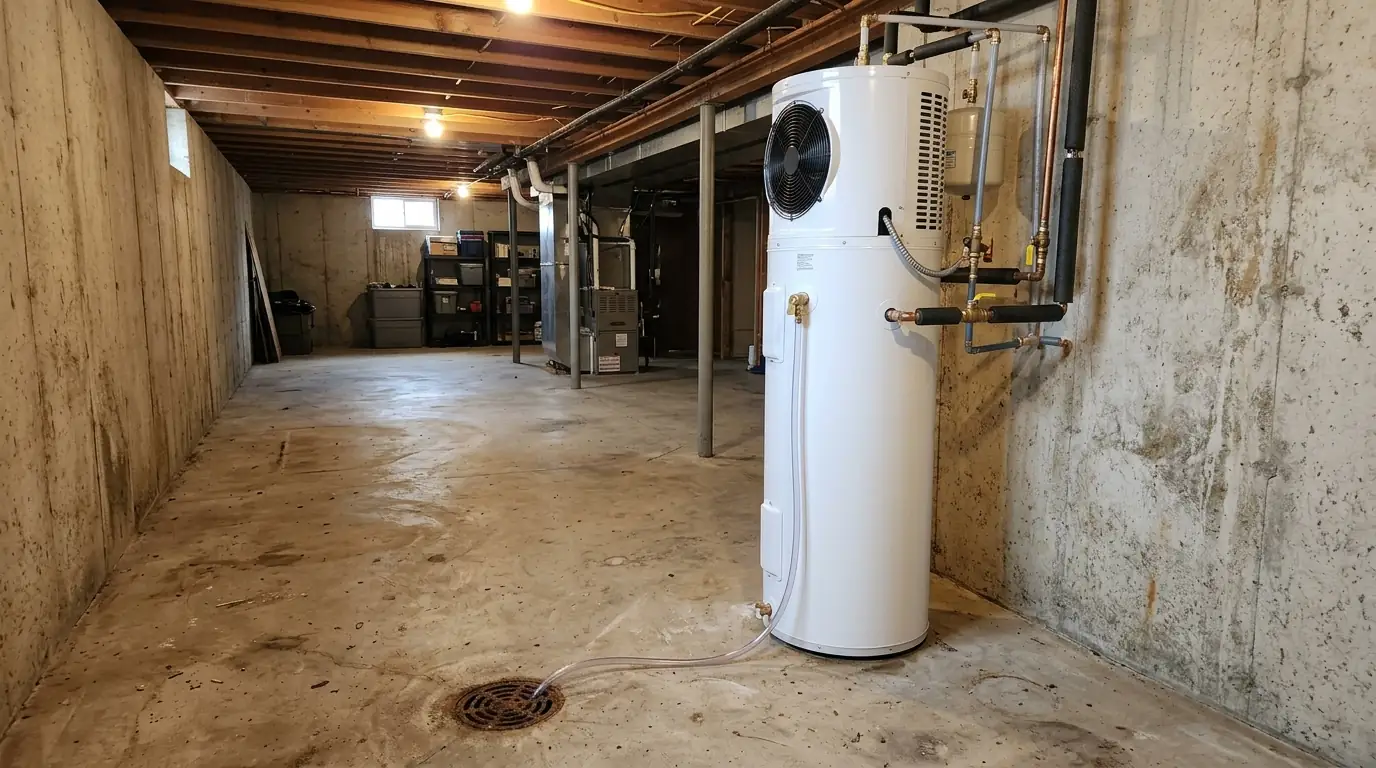
A heat pump water heater installation in Philadelphia suits homes with an electric tank and a basement that has room and air around the heater. The unit uses a small heat pump on top of the tank to pull warmth from the room, with electric elements as backup. It needs a condensate drain, a suitable circuit and enough clearance to work efficiently.
How a heat pump water heater earns its keep
A heat pump water heater works like a refrigerator in reverse. A fan draws basement air across a coil, the heat pump moves that warmth into the tank, and cooler, drier air goes back into the room. Electric elements take over when demand runs high or the room gets too cold.
Plenty of Philadelphia basements suit these units, being unfinished and roomy enough. We install models from makers such as Rheem and A. O. Smith. For homes that already burn gas, a gas tank replacement or tankless may still make more sense, and we will say so. Our water heater cost guide covers how the types compare.
Heat pump tank versus a standard electric tank
For homes without gas, this is the comparison that matters.
| Point | Heat pump water heater | Standard electric tank |
|---|---|---|
| How it heats | Pulls heat from room air, elements as backup | Elements only |
| Running cost | Lower, since it moves heat rather than making it | Higher |
| Space needed | Taller unit with open air around it | Fits a small closet |
| Extras | Condensate drain, sometimes a pump | Drain pan only |
| Effect on the room | Cools and dries the basement air | None |
What shapes the price of a heat pump install
The unit is the bigger share of the price, and the extras depend on your basement.
- Tank sizeLarger tanks cost more but carry a busy household through mornings without leaning on the elements.
- Condensate routeA gravity line to a nearby drain is simple; a pump adds parts and wiring.
- Electrical changesIf the circuit does not match the unit, the electrical work adds cost.
- Space changesLouvered doors or ducting for a small room add to the job.
- Removal and permitHauling out the old tank and any permit are part of the price.
Electric Tank to Heat Pump
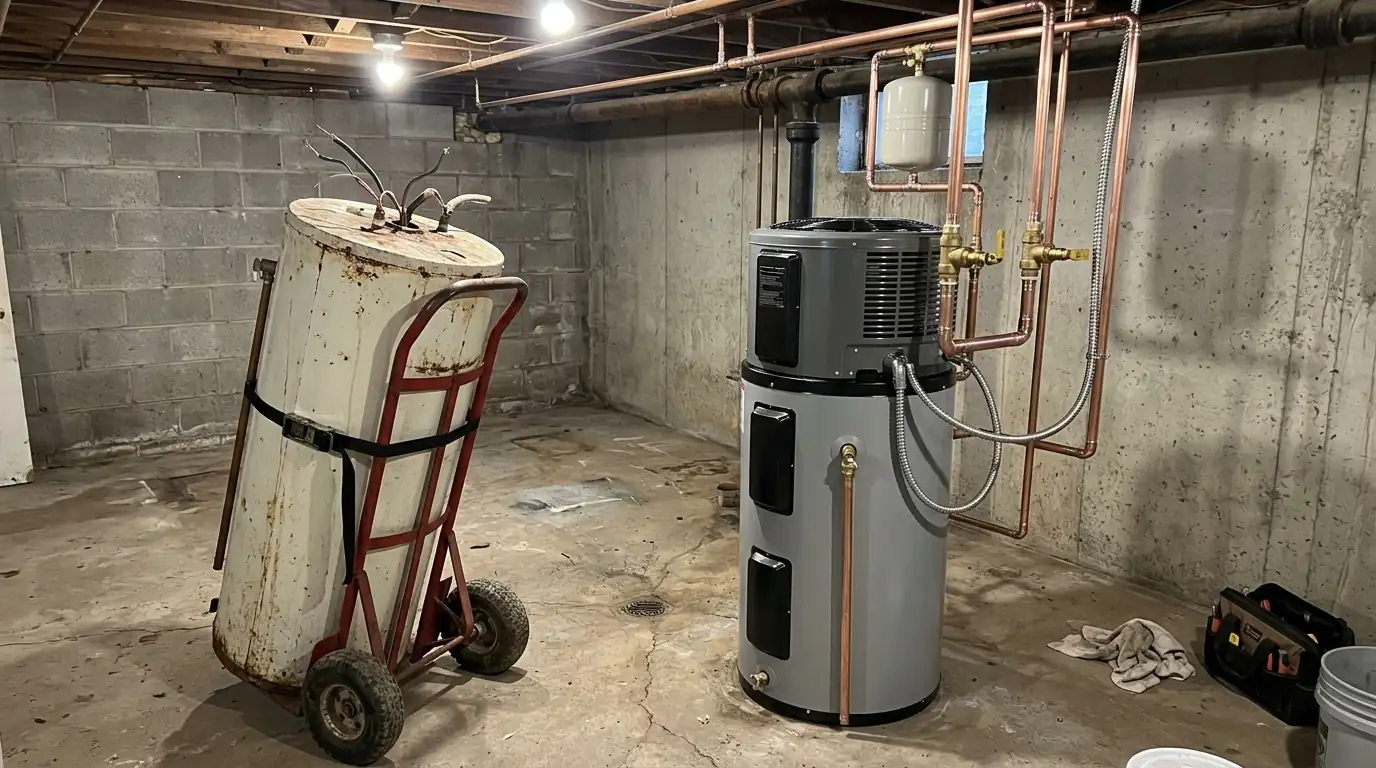
Swapping an electric tank for a heat pump unit is the simplest case. The water connections stay in roughly the same place and there is no gas or venting to deal with. What changes is height, weight and the electrical side. Heat pump units stand taller than most standard tanks, so we measure under the joists and any ductwork first. Many models run on the same circuit as the old tank, but we confirm the breaker and wire size against the new unit's label instead of assuming. We set the operating mode so you get the savings without running short on busy mornings.
Condensate Drain Setup
Pulling heat from the air also pulls out moisture, and that water has to go somewhere. The unit has a condensate outlet that needs a line to a floor drain, laundry tub or sump pit. Where the heater sits below the nearest drain, we fit a small condensate pump. Lines are run with a steady slope, secured along the wall and kept out of walkways. A blocked or kinked condensate line is the most common reason these units leave water on the floor, so we route it where you can see it and keep it short where we can.
Basement Space Check
A heat pump water heater needs air to work with. Each manufacturer lists a minimum room volume and clearances around the unit, and a small closet usually falls short unless it has louvered doors or ducting. The room also has to stay within the unit's operating temperature range, which an unheated basement often does. We consider noise, since the fan and compressor hum like a dehumidifier, and whether the cooled air will bother anyone using a finished part of the basement. If the space fails the check, you hear it from us before you buy.
What the installation includes
The job looks like an electric tank swap with a few additions.
- Space and air volume check before ordering
- Old tank drained and removed
- Circuit and wire size checked against the new unit
- New heater set level in a drain pan
- Condensate line run to a floor drain, laundry tub or pump
- Expansion tank and relief line fitted
- Operating mode set and air filter cleaning shown
How we put in a heat pump water heater
Check the room
We measure the space, ceiling height, air volume and drain options.
Confirm the electrical
The circuit, breaker and wire are checked against the new unit.
Remove and set
The old tank is drained and taken out and the new unit set in a drain pan.
Pipe and drain
Water lines, relief line, expansion tank and condensate drain are installed.
Start up and set modes
We fill the tank, power it up, confirm the heat pump runs and choose the operating mode.
Where heat pump heaters fit near our office
A heat pump water heater pays back over years, so it makes most sense for owners who plan to stay put. Near our office in the Far Northeast that describes a lot of households: Pew's analysis found Parkwood above 80 percent owner-occupied, with Somerton among the most stable parts of the city. Whether a given basement has the room and air these units need is a separate question, and we answer it with a tape measure before you commit.
Questions about heat pump water heater installation in Philadelphia
It cools and dries the air around it, a bit like a dehumidifier. In an unfinished basement that is rarely a problem and can even help with damp.
The fan and compressor make a steady hum, similar to a dehumidifier. From a basement it is seldom noticed upstairs.
Only if the closet meets the unit's air volume, or has louvered doors or ducting. We check this before you buy.
If the room gets too cold for the heat pump, the unit switches to its electric elements, so the hot water keeps coming.
No, they run on electricity. If you already have gas, compare it with a tankless unit or a gas tank before deciding.