Updated October 2026
A water softener in Philadelphia removes the calcium and magnesium that leave scale on fixtures, glass and the inside of water heaters. City water runs from moderately hard to hard depending on the treatment plant. We test your water, size the softener to your household, install it on the main after the meter with a bypass, and connect its drain.
What hard water does inside a house
Hard water carries dissolved calcium and magnesium. Heat drives them out, which is why scale builds fastest in water heaters, kettles and shower heads. You see it as white crust on faucets, spots on dishes and soap that will not lather well.
A softener trades those minerals out as water passes through resin, then cleans itself with brine on a schedule. It protects fixtures and appliances, including a tankless heater that would otherwise need regular descaling. It does not fix taste or sediment; that is a filtration job.
Softener price factors
Most of the difference between two quotes comes from the unit itself and the plumbing around it.
- CapacityLarger households need a larger resin tank.
- Control headHeads that meter water use cost more than simple timers but waste less salt.
- Drain locationA long drain run or no nearby floor drain adds work.
- Removing an old unitTaking out a failed softener and updating its bypass adds time.
- SaltSalt is an ongoing cost, smaller with a well-set unit.
New Softener Installs
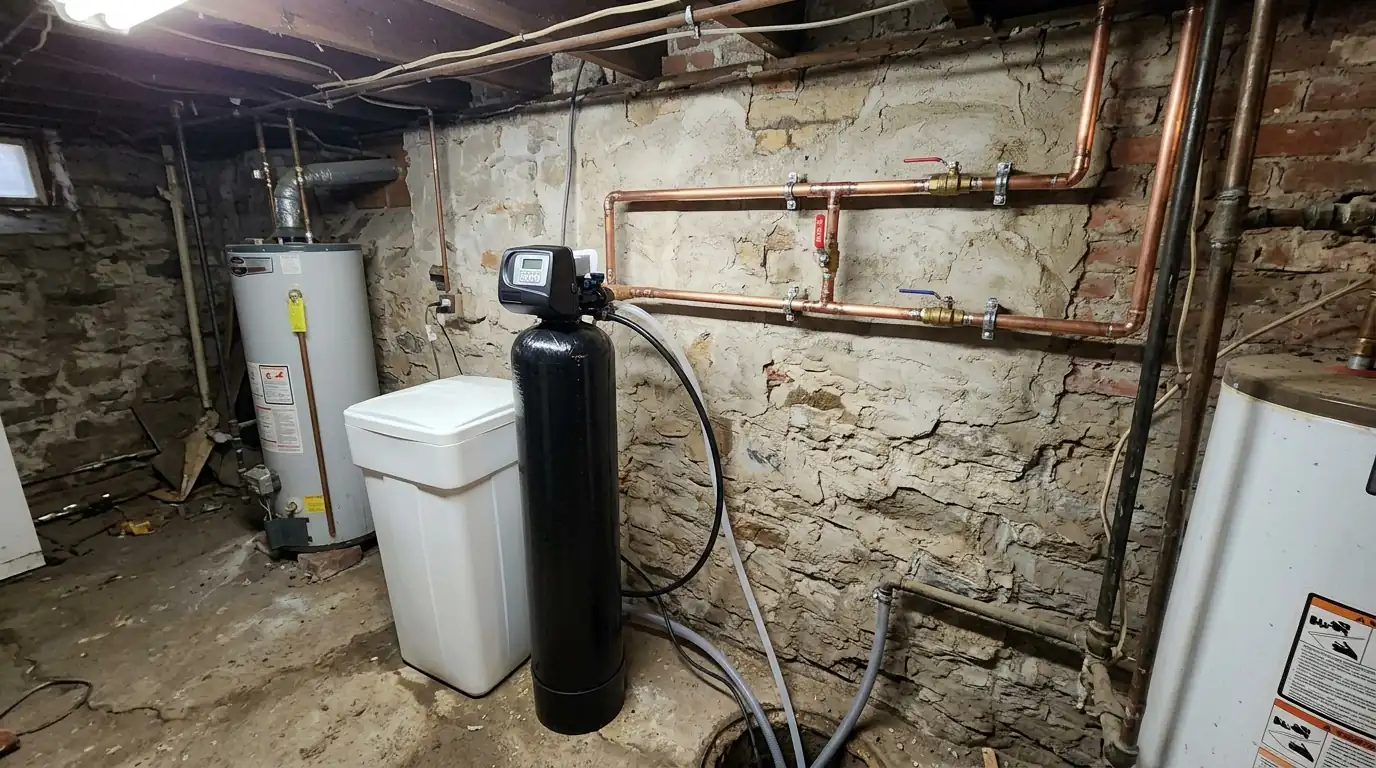
A first softener goes on the main supply after the meter and before the water heater, so hot water gets the most benefit. In a rowhome basement the challenge is fitting the resin tank and brine tank somewhere near both the main and a drain. We test your hardness, size the unit to your household and pipe it in with a bypass, so you are never without water. The drain runs to a floor drain, laundry tub or standpipe with a gap that keeps wastewater out of the softener. Space, the drain location and whether outdoor taps should stay unsoftened decide the layout.
Softener Replacement
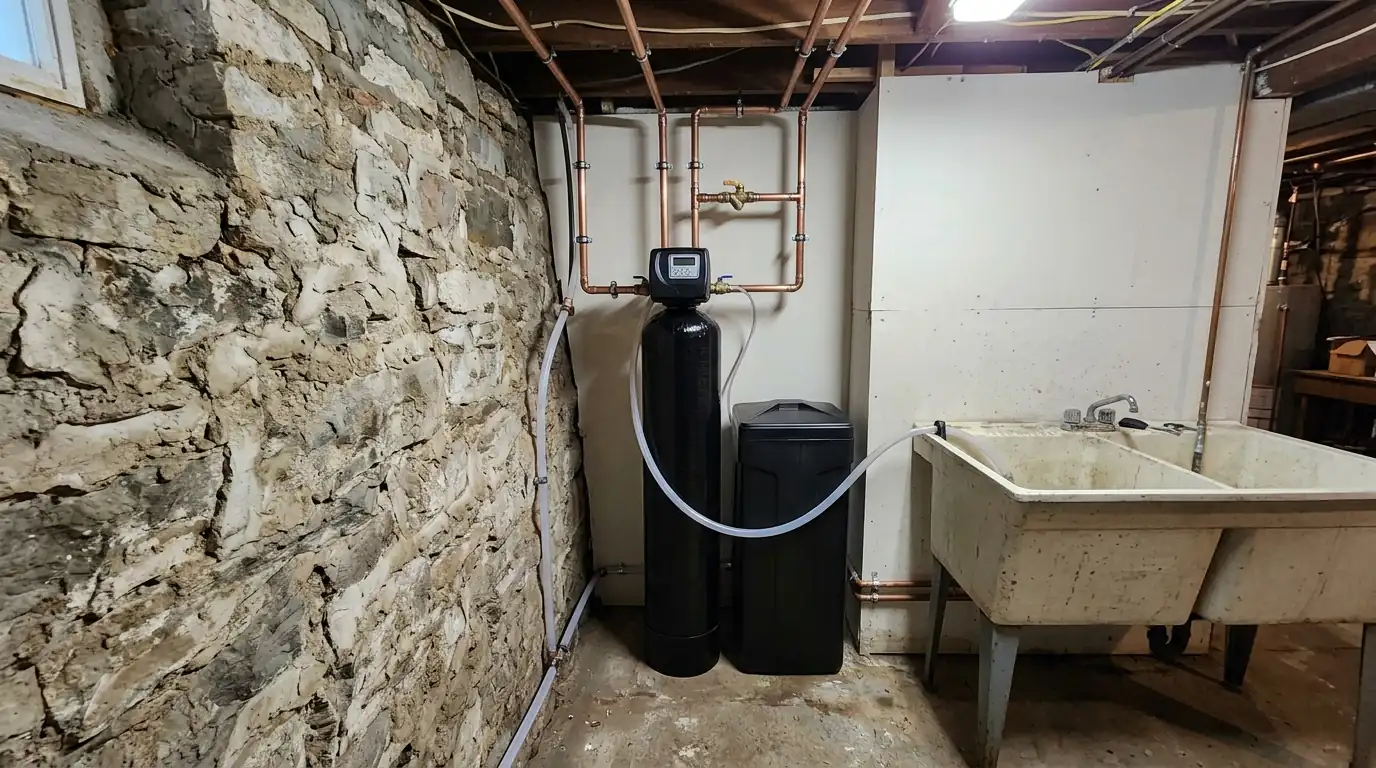
An old softener gives itself away. Hard water creeps back, the salt in the brine tank never goes down, or the control head stops regenerating at all. Sometimes the resin has simply worn out after years of chlorinated city water. We check whether the control valve can be repaired first. If the unit is too far gone, we remove it and set a new one in the same spot, updating the bypass and drain connection while we are there. Age, parts availability and whether the old unit was sized right in the first place decide between repair and replacement.
Bypass Valve Setup
Plenty of softeners went in without a working bypass, or with one buried behind shelving. Without it, servicing the unit means shutting water off to the whole house. We fit a bypass, either the control head's own or a three-valve loop in the copper, so the softener can be isolated while the house keeps water. It also lets you send unsoftened water through during a repair or while you are away. We make sure each valve closes fully, because a valve that seeps lets hard water mix back in without anyone noticing.
What a softener install includes
Every install covers the same core pieces, fitted to your basement.
- Hardness test at one of your taps
- Softener sized to your household
- Connection on the main after the meter
- Bypass so the house keeps water during service
- Drain line for regeneration water
- Brine tank set level and loaded with salt
- Control head programmed for your hardness
- Outdoor faucets left on unsoftened water if you prefer
Softener chores you can handle
Day to day, a softener asks very little of you. A few jobs are better left alone.
| Task | Safe to do yourself | Call a plumber |
|---|---|---|
| Add salt to the brine tank | Yes. Keep it topped up without overfilling. | If the salt forms a hard crust that will not break up. |
| Put the unit in bypass | Yes. We show you the handle position at install. | If the bypass leaks or will not turn. |
| Reprogram after the household changes | Yes, if the manual is clear. | If water stays hard after regeneration. |
| Reroute the drain line | No. The drain needs a proper gap above it. | Always. |
Softener install steps
Test the water
We measure hardness at a tap so the unit is set for your supply.
Pick the location
We find a spot near the main, a drain and an outlet.
Cut into the main
The softener goes in with a bypass and shutoffs.
Run the drain and set the brine tank
Drain and overflow lines are run and the brine tank is filled.
Program and start
We set hardness and schedule, then run the first regeneration.
How hard Philadelphia water gets
PWD's 2024 water quality report lists one-year hardness averages of 98 ppm at the Baxter plant, 152 ppm at Belmont and 168 ppm at Queen Lane. That spread runs from moderately hard to hard, so two Philadelphia homes can see quite different amounts of scale. Which plant feeds your house decides where you fall in that range. We test at your tap before programming the softener, rather than guessing from a citywide average, so it regenerates as often as your water needs and no more.
Questions about water softener installation in Philadelphia
It depends on how much scale bothers you. City water runs from moderately hard to hard, and owners with tankless heaters or glass shower doors tend to notice it most.
Most people notice no taste. If you prefer, we can leave the kitchen cold tap unsoftened or pair the softener with a drinking water filter.
To a floor drain, laundry tub or standpipe, with an open gap above it so wastewater cannot flow back into the unit.
That depends on your water use and hardness. Check the brine tank monthly at first and you will soon learn the rhythm for your household.
Yes. Less scale means less sediment settling in a tank and less descaling on a tankless unit, which keeps both heating efficiently.