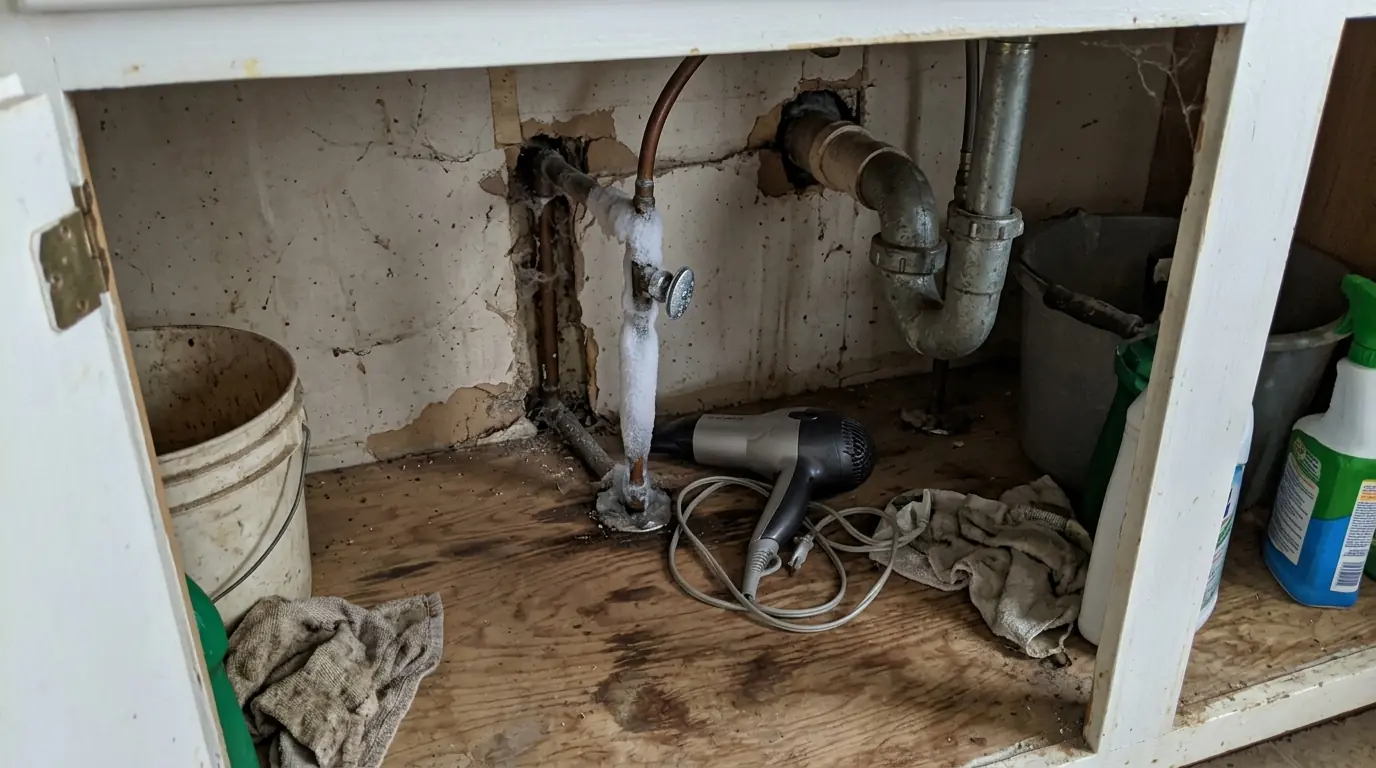
In Philadelphia, pipes are most at risk when temperatures stay below 32 degrees for more than 72 hours, especially overnight when water sits still. If a faucet stops running, open it, find the frozen stretch, and warm it gently with a hair dryer or warm towels. Know where your main shutoff is first, because a thawing pipe may already be split.
First, find your main shutoff
Before you warm anything, walk to the basement and find the main valve beside the water meter, usually where the service line comes through the front wall. Put your hand on it. If it is an old gate valve that will not budge, you want to know that now, not when water is spraying from a ceiling.
A frozen pipe often cracks while it is frozen and only leaks once the ice melts. If you hear running water or see a drip as you thaw a line, close the main and call. A seized main valve is worth replacing with a quarter-turn ball valve before next winter; see shutoff valve replacement.
Work out where the ice is
Run every faucet in the house. The ones that still flow tell you which pipes are fine. The ones that do not narrow down the frozen stretch.
- Only the kitchen is dead: the pipe probably runs through a back addition wall or over a crawlspace.
- Every fixture is dead: the meter or the service line where it enters the house may be frozen.
- One bathroom upstairs is dead: look for supply pipes in an outside wall or under a window.
- The outdoor hose bib is frozen and split: close its inside shutoff if it has one.
Thawing it the safe way
Open the faucet the frozen pipe feeds so melting water and pressure have somewhere to go. Then work from the faucet end back toward the ice, not the other way round, so meltwater is not trapped between two plugs of ice.
Use gentle heat: a hair dryer, a heating pad, or towels soaked in hot water and wrapped around the pipe. Open the cabinet doors under the sink and let warm room air in. If the frozen stretch is inside a wall, raising the heat in that room and aiming a space heater at the wall, kept well clear of anything that burns, can be enough.
Never use an open flame, a propane torch or a heat gun on a frozen pipe. Flame can start a fire inside a wall and can heat a section of pipe fast enough to split it. If you cannot reach the frozen stretch or it is not thawing, that is the point to call for frozen pipe thawing.
Rather have a plumber look at it?
We answer around the clock for Philadelphia, Montgomery County and lower Bucks County.
Call (267) 394-6446Why Philadelphia gets hit so hard in a cold snap
Pipes are at greater risk of freezing and bursting when temperatures stay below 32 degrees for more than 72 hours, especially when water sits unused overnight. Short dips rarely do it. Long runs of cold do.
PWD has seen what that looks like. In one winter it fielded 1,295 cold-weather calls, and 1,143 of them came during an eight-day February stretch that never rose above freezing and dipped to two degrees. Old housing adds to the risk: units built in 1939 or earlier make up 41 percent of housing in Philadelphia County, and plenty of them have kitchens in back additions with thin walls and pipes run wherever they fit.
After it thaws, check for damage
Once water flows again, do not walk away. Watch the thawed section for a few cycles of use. Look at the pipe for a hairline split or a bulge, and check ceilings, cabinet floors and the basement below for drips. Read the water meter with everything off; if the dial still creeps, there is a leak somewhere.
A split copper pipe gets cut out and replaced, not taped. If you find one, close the main and call for burst pipe repair.
Keeping it from happening next cold snap
The fixes that work are simple, and most are free.
- During long freezes, let the faucet on the cold wall drip overnight so water keeps moving.
- Leave sink cabinet doors open on outside walls.
- Close and drain the inside valve for every outdoor faucet in the fall.
- Insulate pipes in crawlspaces, unheated back additions and along the front wall near the meter.
- Seal drafts where cold air hits the pipes, such as gaps around the service line entry.
- If you leave the house in winter, keep the heat on and have someone check it.
If the pipe has already split
Water pouring from a ceiling or a wall means the pipe burst as it thawed. Close the main valve at the meter straight away, then open the lowest faucet in the house, usually a basement laundry tub, to drain the pressure out of the lines. That shortens how long the leak keeps running.
If water is coming through a ceiling near light fixtures, switch off that circuit at the panel before you go near it. Move furniture and electronics out of the way, put buckets under the drips, and if a ceiling is bulging with water, poke a small hole at the lowest point over a bucket so it drains in one place instead of collapsing.
Then take photos of the damage, the split pipe and the room before cleanup, which helps if you file an insurance claim. Leave the main off until the broken section has been cut out and replaced, and the line is pressure checked.
Questions owners ask
During a long freeze, yes, for the faucet on the coldest wall. Moving water is far harder to freeze than water sitting still, which is exactly when pipes are most at risk.
No. Open flame can start a fire inside a wall, and concentrated heat can split the pipe. Use a hair dryer, heating pad or hot towels, and call if that does not work.
Do not try to warm the meter with flame. Warm the basement area around it and the pipe coming through the wall gently. If the meter or its fittings crack, close the main and call.
Often you cannot until it thaws. Watch for water stains, drips, a hissing sound, or a meter dial that keeps moving with every fixture off.
Not before, but know exactly where the main is and that it turns. If a leak appears while you thaw, close it right away.
Supply lines in back addition kitchens, pipes in outside walls, lines over crawlspaces, the service line and meter near the front wall, and outdoor hose bibs.