In Philadelphia the property owner is responsible for the sewer lateral, the pipe that carries waste from the house to the sewer main in the street. That includes the section under the sidewalk and often under part of the road. PWD owns the main itself. Repairs after a PWD Notice of Defect can be financed with a zero-interest HELP loan repaid over 60 months.
Following the pipe from your toilet to the street
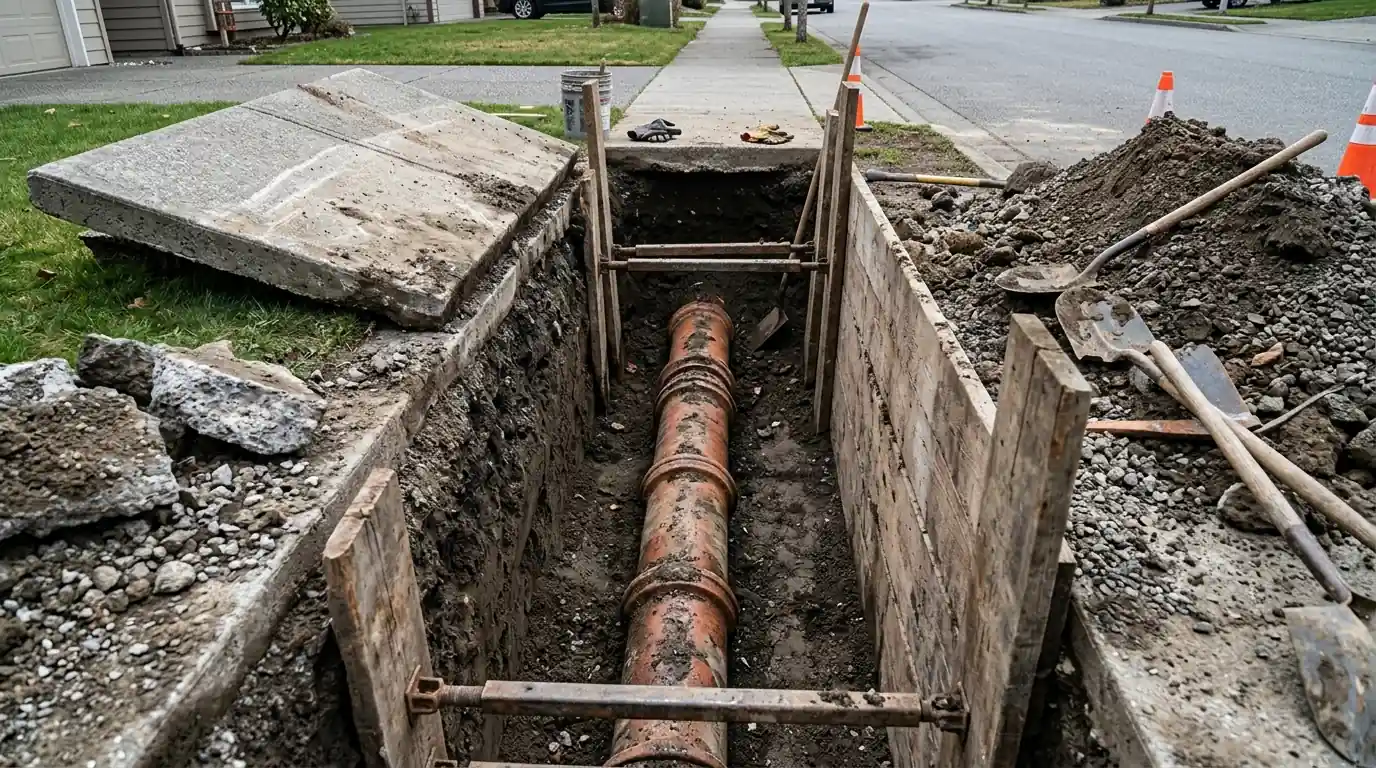
Picture the path of a flush. Water drops down the cast iron stack, runs along the basement to the front wall, usually passes through a house trap, and leaves the building. From the foundation to the city sewer main, that pipe is the lateral. It runs under the front yard or steps, under the sidewalk, and under part of the street to meet the main.
In Philadelphia the property owner is responsible for the water service line and the sewer laterals that connect the house to the mains in the street. The line of responsibility is not the curb or the property line. It is the connection at the main.
So a sinking patch of sidewalk, a wet spot near the curb or a backup that keeps returning after every cleaning can all point to a pipe that is yours to repair, even though it sits under public pavement. Knowing that early helps you plan instead of waiting for the city to act.
Some houses have two laterals, not one
In parts of the city a house carries a sanitary lateral for sewage and a separate storm lateral for roof and yard water. When PWD investigated two Northeast Philadelphia blocks, 48 of 80 homes had lateral or vent problems, and each home there had two laterals and two vents, one for the storm sewer and one for the sanitary sewer.
That matters when something goes wrong. A downspout line can be broken while the sanitary side is fine, or the other way around. Before any digging, we run a camera through the right line and confirm which pipe has the defect, so you are not paying to open the wrong trench.
What actually fails in an old lateral
Many Philadelphia laterals are old clay or cast iron, and they fail in predictable ways.
- Root intrusion through joints, which builds into a mat that catches paper.
- Offset joints, where one section of pipe has settled lower than the next.
- Collapsed terra cotta, often under a sidewalk that has started to sink.
- Cracked or rotted cast iron near the foundation wall.
- Bellies, sagging stretches that hold water and debris.
Rather have a plumber look at it?
We answer around the clock for Philadelphia, Montgomery County and lower Bucks County.
Call (267) 394-6446When PWD sends a Notice of Defect
If PWD finds a defect in a lateral that the owner is responsible for, it can issue a Notice of Defect. That is your cue to get the line repaired. PWD's Homeowner's Emergency Loan Program, HELP, offers a zero-interest loan for repairs after a Notice of Defect, repaid over 60 months on the water bill.
A defect also blocks other city help. The Basement Backup Protection Program requires broken pipes to be fixed before it will install a free backwater valve, through a HELP loan or a private plumber. Fixing the lateral first can open that door.
Planning numbers for lateral work
Every lateral is different, and depth, length and what sits on top drive the final price. As national planning ranges, Angi puts sewer line repair at 50 to 250 dollars per linear foot, and full sewer line replacement at an average of 3,319 dollars within a range of 1,388 to 5,323 dollars. Trenchless methods run 60 to 250 dollars per linear foot nationally.
Use those to judge whether a quote is in the right territory, not as a price for your house. A lateral that runs under a street, or one deep below a rowhome front step, can land well outside a national average. We put the price in writing after the camera shows what is down there.
Repair, line or replace
A single bad joint or a short collapsed section near the house can often be dug and repaired. Where the whole run is cracked but still holds its shape, lining or pipe bursting can renew it with less excavation. Where it has collapsed or bellied badly, open trench replacement is the honest answer.
Our lateral repair and sewer line replacement pages explain each method. If you are still deciding whether the problem is the lateral at all, a camera inspection answers that before anyone picks up a shovel. For the fitting just inside your front wall, see our house trap guide.
Questions to settle before anyone digs
A lateral job touches the sidewalk, sometimes the street, and always your budget, so it pays to get the facts straight first. Ask for the camera footage and keep a copy. It should show the distance from the cleanout to each defect and roughly how deep the pipe sits, which is what decides between a spot repair and a full run.
Then go through the practical side with whoever is quoting:
- Which pipe has the defect, sanitary or storm, and how was that confirmed?
- Where exactly will the ground be opened, and who restores the sidewalk or paving?
- Is a permit or street opening needed, and is it included?
- Will the house trap and cleanouts be replaced at the same time, or left as they are?
- If you received a Notice of Defect, does the scope match what PWD flagged?
Questions owners ask
Yes. In Philadelphia the owner is responsible for the sewer lateral all the way to the connection at the main, which often includes pipe under part of the street. PWD owns the main.
A camera run from the house tells you. If the lateral is clear to the connection and the backup only happens in heavy rain, the main or a sewer surcharge is the more likely cause.
It is PWD's notice that a defect was found in a line the owner is responsible for. Repairs made after one can be financed through the HELP loan at zero interest over 60 months.
Policies vary a great deal, and many exclude wear or need a separate service line rider. Read your policy or ask your agent before the work starts.
Often, yes, for a while. Cabling or jetting removes roots, but they return through the same joints. If the camera shows cracked or offset joints, a repair stops the cycle.
Many older homes have a house trap with two cleanout caps, and some houses also have a separate storm line. We identify which pipe each opening serves before clearing anything.