A house trap is a U-shaped fitting on the main drain, usually at the front basement wall of older Philadelphia homes. Water sitting in its bend blocks sewer gas coming from the street, two cleanout caps give access for clearing, and a fresh air vent lets air into the drains. When it clogs, every basement fixture backs up together.
Finding the trap in your basement
Stand at the front wall of the basement, the side facing the street, and follow the big drain pipe to the point where it leaves the house. In many older homes you will see a U-shaped bend sitting at or just below the floor, with two round caps on top of it. That is the house trap, which some plumbers call a running trap.
Sometimes the trap sits in a shallow pit with a metal plate over it, or it is hidden behind paneling, a shelf unit or a drop ceiling when the basement has been finished. Homes built more recently, and some that were gutted and replumbed, have no trap at all. If you look and cannot find one, that is not always a problem, but it is worth knowing before you ever have a backup.
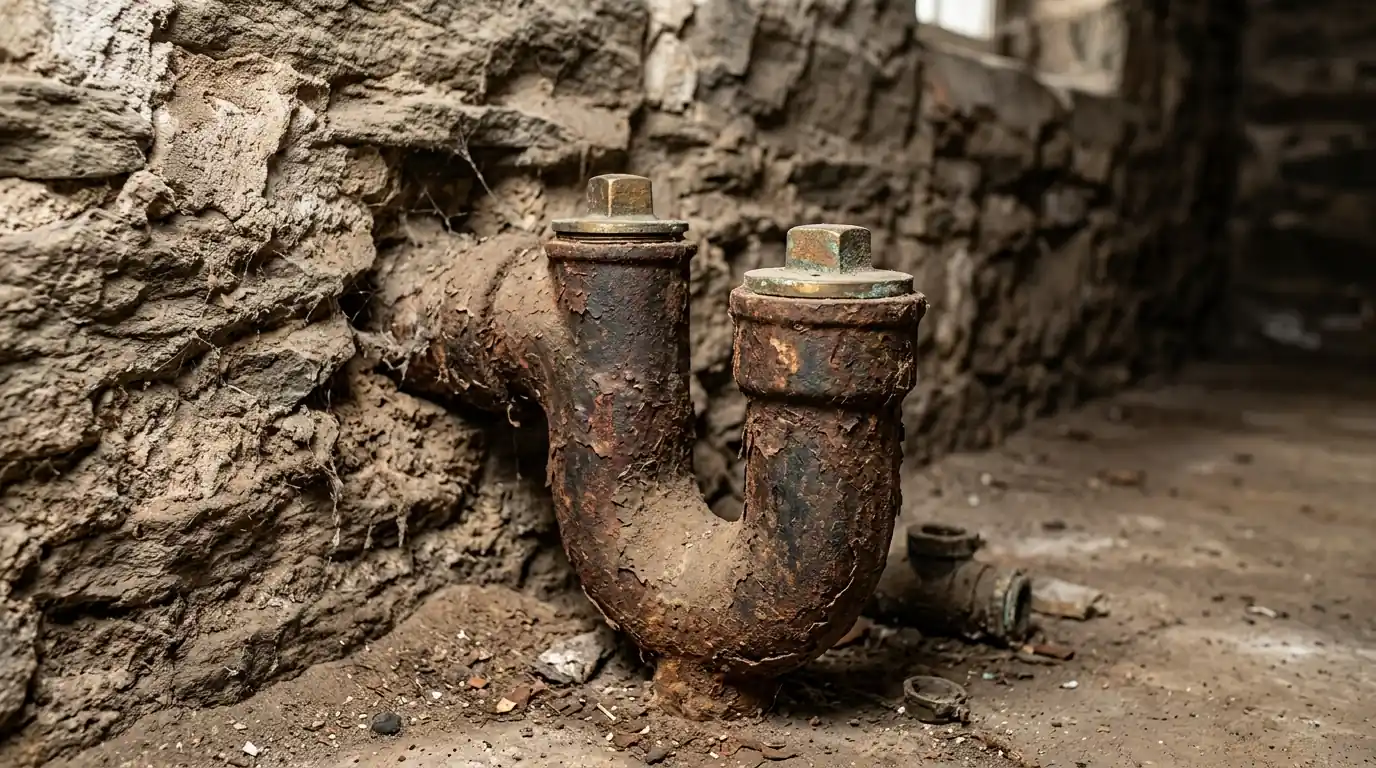
How a few inches of water keep sewer gas out
The trap works the same way the bend under your kitchen sink does, only bigger. Wastewater runs down into the bend and up the other side toward the street, and when the flow stops, the low part of the U stays full. That standing water is the seal. Gas from the sewer main reaches the street side of the bend and stops there.
The two caps matter because they sit on either side of the seal. The cap nearest the street opens into the lateral that runs out to the main, and the cap nearest the house opens into the drains inside the house. Plumbers use them to clear the trap, run a cable toward the street or feed a camera into the line. A cap that is missing, cracked or loose breaks the whole arrangement, because sewer gas simply goes around the water instead of through it.
The vent by the sidewalk and why it exists
On the house side of the trap, a smaller pipe usually rises toward the front of the property and ends at a vent near the sidewalk or the front step. This is the fresh air inlet. It lets air into the drain system so water can move freely, and it keeps the rush of a flushed toilet upstairs from pulling on the trap seal.
Because the vent sits at ground level, it gets crushed during sidewalk and step repairs, packed with leaves, or capped by someone who wanted to stop a smell. When that happens drains across the house can slow down, and sewer odor can show up near the vent outside. In a PWD investigation of two Northeast Philadelphia blocks, 48 of 80 homes had lateral or vent problems, and each home there had two laterals and two vents, one set for the storm sewer and one for the sanitary sewer. That is a good reminder to know which pipe you are looking at before anyone starts clearing it.
Rather have a plumber look at it?
We answer around the clock for Philadelphia, Montgomery County and lower Bucks County.
Call (267) 394-6446Signs the trap needs attention
Most trap trouble announces itself in a few predictable ways. If you notice any of these, the trap and its vent are the first things to check:
- Water rising out of the floor drain, laundry tub and basement toilet at the same time
- A sewer smell near the front wall that comes back after you pour water into the drains
- Water weeping from around one of the cleanout caps when upstairs fixtures are used
- A damp patch on the floor near the trap that never fully dries
- Gurgling in basement drains when a toilet is flushed on an upper floor
- Odor at the sidewalk vent, or a vent cap that is missing or buried
The cleanout test plumbers use, and why you should not try it mid-backup
When every basement fixture backs up together, the first question is whether the blockage is in the trap or past it in the lateral. A plumber answers it by slowly opening the cap on the street side. If water pushes out, the clog is downstream in the lateral, and the job becomes a main line cleaning or a camera run. If the street side is dry, the trap itself is blocked.
Please do not do this yourself while water is standing in the basement. Everything upstream of the cap is under pressure, and a cap that comes loose all at once can put a lot of sewage on the floor in a hurry. Stop using water upstairs, keep people and pets away from the floor drain and call. We will talk you through what to leave alone until a plumber gets there.
Clearing, replacing or keeping the trap
A clogged trap usually clears with a cable through the cleanout. A cast iron trap that has rotted along the bottom of the bend, or hubs that have cracked around a seized cap, is a different story. Patches rarely hold on old cast iron, so the usual fix is cutting the trap out and fitting a new one with fresh cleanouts, joined to the old pipe with shielded couplings. Our page on house trap repair walks through that work in more detail.
Owners sometimes ask whether the trap can simply be taken out. That is a question for the plumbing code and the city inspector, not a decision to make on the spot. We check what the inspector will pass for your line before we recommend anything, and we pull the permit when the work needs one.
Who is responsible for the trap and the line beyond it
Just over 40 percent of Philadelphia homes were built before 1940, so a great many of them still have their original trap. In Philadelphia the property owner is responsible for the water service line and the sewer laterals that connect the house to the mains in the street. The trap sits on that owner side, and so do the fresh air vent and the lateral beyond it. Our guide to sewer lateral ownership explains where the owner's part ends and the city's begins.
Questions owners ask
It works on the same principle, a bend that holds water as a seal, but it serves the whole house instead of one fixture. It sits on the main drain at the front wall and has cleanout caps and a fresh air vent that a fixture trap does not.
The usual causes are a dried out floor drain, a missing or cracked cleanout cap, or a crack in the trap. Pour a bucket of water into each floor drain and check both caps. If the smell returns within days, the trap or vent needs a closer look.
Capping it solid takes away the air the drain system needs and can slow drains through the house. If it smells or collects debris, the better fix is finding out why and fitting a proper cap that keeps leaves out while still letting air in.
There is no fixed schedule. A trap that has never given trouble can be left alone, while one that clogs repeatedly is telling you something about the pipe beyond it. A camera inspection shows whether roots or a sagging lateral are the real cause.
No. The trap keeps sewer gas out, while a backwater valve closes when sewage flows backward toward the house. They do different jobs and can sit on the same line. Our basement water guide explains how a valve fits in.
Some homes, including the Northeast Philadelphia blocks in the PWD study, have separate laterals for the storm sewer and the sanitary sewer, each with its own vent. We trace which line each trap serves before clearing or replacing anything.