In Philadelphia, a basement that floods through the floor drain during heavy rain is usually taking water from an overloaded city sewer. About 60 percent of the city runs on combined sewers that carry sewage and stormwater together. A backwater valve on the house drain lets water out but closes when the sewer pushes back, and PWD offers free installation to eligible owners.
Why the water comes up instead of going down
About 60 percent of Philadelphia is served by combined sewers, one pipe that carries both sewage and stormwater. On a dry day that pipe has plenty of room. In a cloudburst, rain from roofs, streets and yards pours into the same pipe your toilets drain into, and the level in the main rises.
Water finds the lowest opening it can reach. In many houses that is the basement floor drain, a basement toilet or a laundry tub. When the sewer main surcharges above that height, it pushes back up your lateral and out through those fixtures. The house drain is working fine. It is simply connected to a pipe that is full.
Northeast Philadelphia residents have reported sealed street drains and basement flooding as a century-old sewer and stormwater system struggles with heavier rain. The Delaware River has also risen about a foot since those sewers were built.
Telling a sewer surcharge from a clog in the house drain
The two look alike on the floor, but they behave differently, and the fix is completely different.
- Surcharge: it happens during or right after heavy rain, often to several houses on the block, and it drains away on its own as the storm passes.
- Clog: it happens on a dry day, usually when someone runs the washer or showers, and it does not go away until the line is cleared.
- Both: a partly blocked lateral makes a surcharge worse, because rain water and house water fight over a narrowed pipe.
How a backwater valve actually works
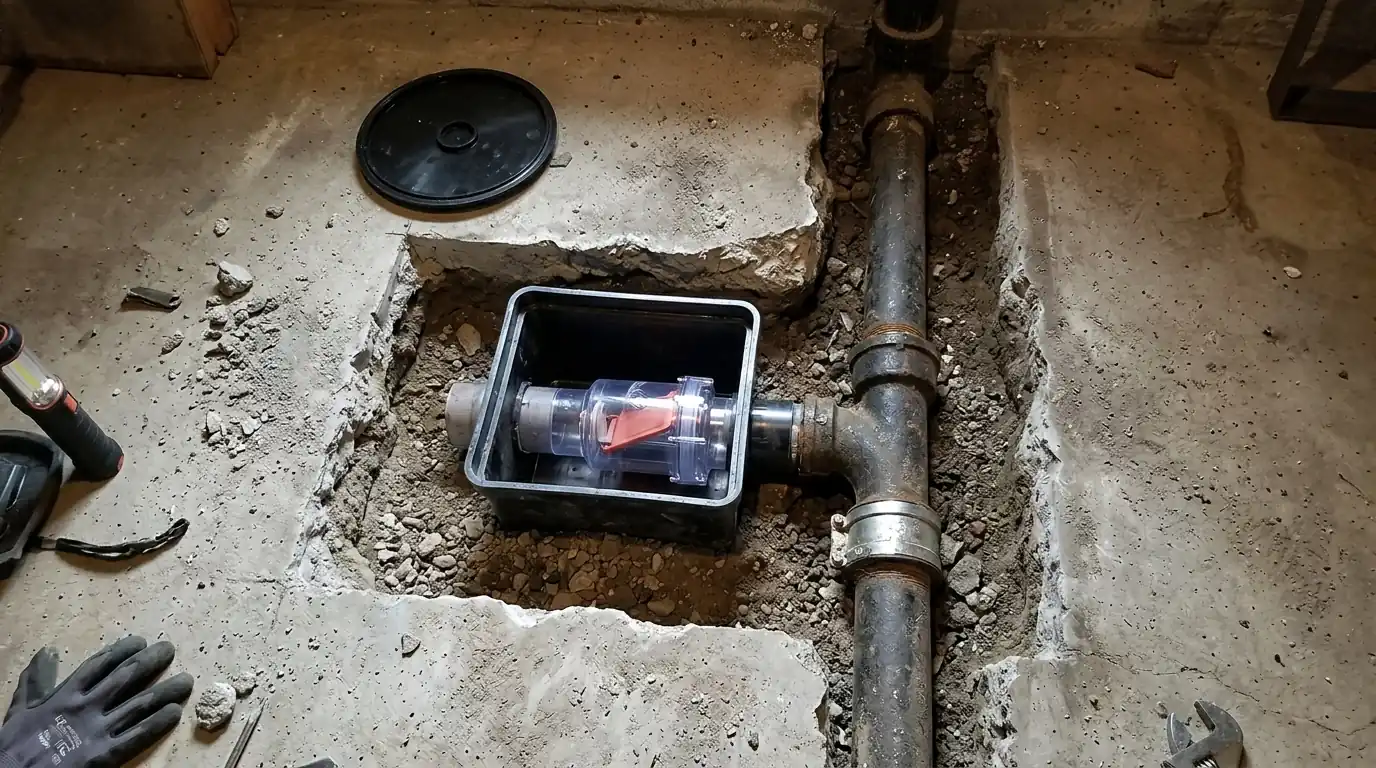
A backwater valve is a one-way gate set into the main drain line inside the house. Normally a flap hangs open or floats out of the way, and everything you flush runs out to the street. When water starts flowing backward from the sewer, the flap swings shut against its seat and holds the sewer water on the street side.
The valve sits in a box set into the basement floor with a removable cover, so it can be opened and cleaned. We cut into the floor, place the valve in the drain line at a point that protects the low fixtures, and finish it with an access lid. The details are on our backwater valve page.
One trade-off to understand: while the valve is closed, nothing in the house can drain past it either. During a storm, go easy on the washer, showers and dishwasher until the street sewer drops.
Rather have a plumber look at it?
We answer around the clock for Philadelphia, Montgomery County and lower Bucks County.
Call (267) 394-6446PWD's Basement Backup Protection Program
PWD runs a Basement Backup Protection Program that offers free backwater valve installation to eligible owners whose basements take sewer backups through basement fixtures in heavy rain. To qualify, PWD lists three conditions:
- The water bill must be current.
- Any PWD violations on the property must be addressed.
- The contractor must be able to reach the plumbing where the valve will go.
When your pipes have to be fixed first
The program also requires broken pipes to be repaired before a valve goes in, either through a HELP loan or a private plumber. That rule makes sense from the plumbing side. A valve set into a cracked or collapsed drain cannot seal, and a lateral full of roots will back up whether or not the valve is there.
This is where we come in most often. We run a camera from the house toward the main, show you the condition of the pipe, and repair what needs repairing so the house can move forward. If the trouble turns out to be a clog rather than a storm, main line cleaning may be all you need.
Keeping the valve working for years
A backwater valve needs attention because grease, paper and grit can hold the flap open just enough to let water by. Open the access lid a few times a year and look at the flap. It should move freely and sit flat when closed. After any backup event, check that nothing is wedged in the seat.
If your basement also takes groundwater through the walls or floor, a valve will not help with that water. Our guide on choosing between a sump pump or a backwater valve walks through which problem you actually have.
If the floor drain is overflowing right now
Stop running water anywhere in the house. Every flush and every load of laundry upstairs has to pass through the same lateral, and while the sewer is surcharged it has nowhere to go but your basement floor. Turn off the washer and dishwasher at the controls.
Stay out of standing water if it is near outlets, the furnace or the water heater burner, and keep children and pets away from it. Sewer water carries bacteria, so wear boots and gloves for cleanup, throw out soaked cardboard and porous items, and disinfect hard surfaces once the water drains. Photograph everything before you move it.
When the storm passes and the water drops on its own, that points to a surcharge. If it stays, the house drain is blocked too, and a plumber should clear and camera the line before the next rain.
Questions owners ask
No. It only stops sewer water coming back up the drain line. Groundwater seeping through walls or the floor slab is a job for a sump pit and pump.
Only lightly. Water from upstairs fixtures will collect behind the closed valve. During a storm, hold off on laundry, long showers and the dishwasher until the sewer drops.
PWD offers it to eligible owners whose basements take sewer backups through basement fixtures in heavy rain. The water bill must be current, PWD violations must be addressed, the plumbing must be reachable, and broken pipes must be fixed first.
A plug or float in a single floor drain can help that one opening, but water will find the next lowest fixture, such as a basement toilet or tub. A valve on the main line protects all of them at once.
Fixture height, lateral condition and where each house ties into the main all vary. A basement with no fixtures below the surcharge level may stay dry while the one next door floods.
Look at it a few times a year and after any storm where you suspect it closed. Clear anything holding the flap open and make sure the lid is sealed.