In a Philadelphia rowhome, a tankless heater makes sense when it can vent through the front or back wall, the gas line can be sized for its much larger burner, and the household wants unlimited hot water more than lower upfront cost. A tank is simpler when the chimney flue is usable, the gas line is small and budget comes first.
Start with the basement you actually have
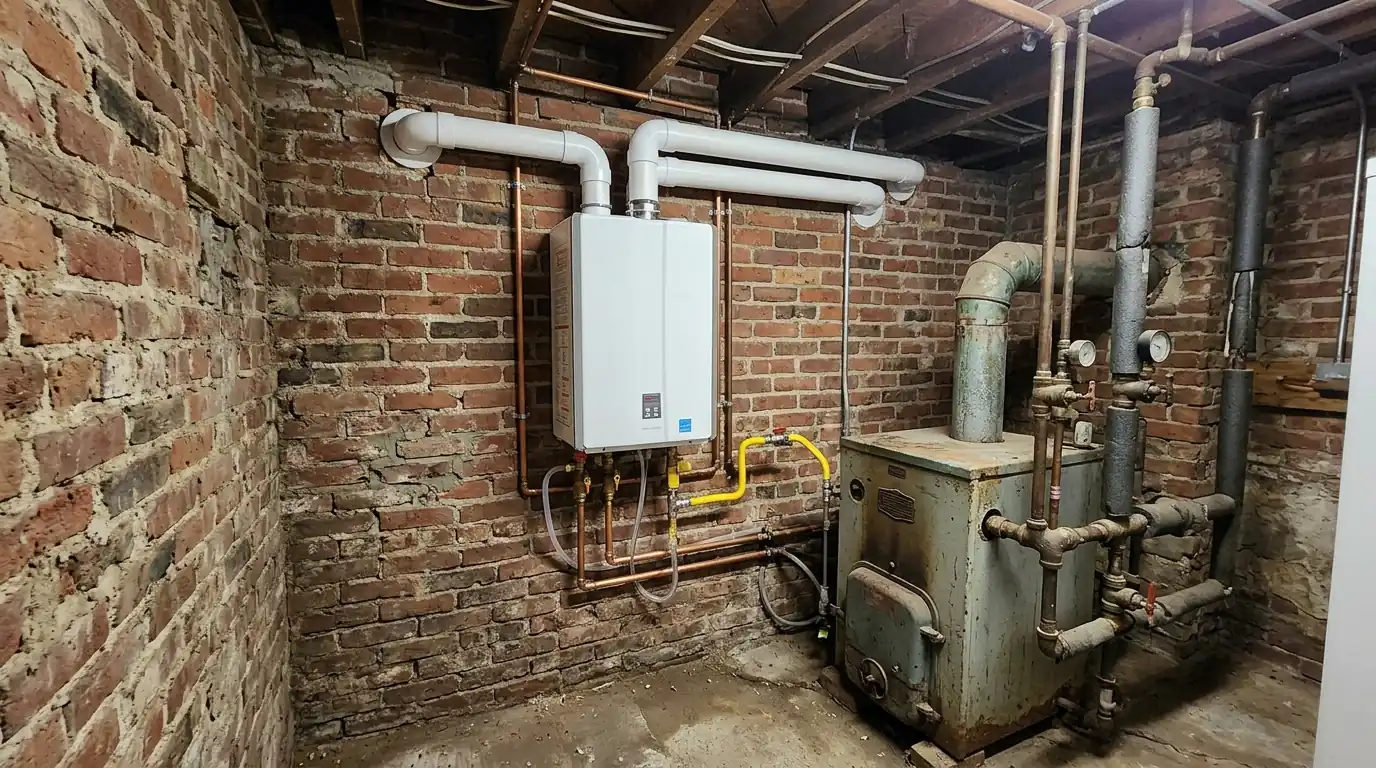
Rowhome basements are long and narrow, with party walls on both sides and exterior walls only at the front and back. The water heater usually sits near the chimney, often beside a boiler or furnace, because that is where the flue is. A tank takes up a round footprint on the floor in that spot. A tankless unit hangs on a wall and frees the floor, which owners like when the basement is tight or partly finished.
Freeing the floor only helps if the new location works for the exhaust, the gas line, the water lines and, for a condensing unit, a drain. In a narrow basement those four things often pull in different directions, and that is where the real decision gets made.
Venting usually decides it
A standard gas tank heater vents by natural draft through a draft hood into the chimney, often sharing the flue with the boiler. That is the cheapest way to replace like for like. The catch is that the flue has to suit whatever is left on it; when a boiler is replaced or moved to its own vent, an old masonry chimney may need a liner before the water heater can keep using it.
A tankless heater, and a power-vent tank, uses a sealed vent pushed out by a fan, and that vent has to leave through an exterior wall or the roof. In a rowhome that means the front or back wall, or a long run up through the house. The terminal has to keep the clearances the manufacturer and code require from windows, doors, walkways and air intakes, which can rule out a front wall that faces a sidewalk with windows next door. Condensing tankless units vent in plastic pipe and also produce acidic condensate, which needs a neutralizer and a drain.
Gas line sizing, the step people skip
A tankless burner fires hard while hot water is running, and it pulls far more gas at that moment than a tank burner ever does. The gas pipe in many older homes was sized for the appliances the house had when it was piped, often a boiler, a range and a tank heater. Add a tankless unit to that same pipe and the burner may starve when the furnace or range is also running, which shows up as error codes and lukewarm showers.
Before we recommend a tankless heater, we add up the demand of every gas appliance in the house and check the pipe size and run length against the fuel gas code sizing tables. Sometimes the existing line is fine. Often a new, larger line from the meter to the heater is needed, which is gas line work that belongs in the quote from the start, not as a surprise on installation day.
Rather have a plumber look at it?
We answer around the clock for Philadelphia, Montgomery County and lower Bucks County.
Call (267) 394-6446Hot water at the far end of a long house
In many rowhomes the heater is at the front of the basement and the bathroom is upstairs at the back. Neither type of heater shortens that walk. Water in the pipe has cooled since the last use, and you wait for it to clear either way. Tankless units can feel slower at first, because the burner has to sense flow and light before the water heats.
Tankless heaters also need a minimum flow to fire, so a faucet barely cracked open may stay cold. On the other side, a tank holds a fixed amount of hot water; two showers back to back, plus a dishwasher, can drain it, and then you wait for it to recover. A tankless unit keeps going as long as the flow stays within what it can heat, and in winter, when the water coming in is colder, that flow drops.
Philadelphia water and scale
PWD's 2024 water quality report lists one-year hardness averages of 98 ppm at the Baxter plant, 152 ppm at Belmont and 168 ppm at Queen Lane, which is moderately hard to hard. Hardness minerals come out of solution when water is heated. In a tank they settle as sediment on the bottom. In a tankless heater they coat the narrow passages of the heat exchanger, which cuts output and can shut the unit down.
Either way, maintenance matters. Tanks do better with periodic flushing and an anode rod check. Tankless units need their heat exchanger descaled on a schedule set by the water and the manufacturer, which is what our tankless service visits cover. Some owners add a softener or a scale filter ahead of the heater to stretch the time between cleanings.
Upfront cost, honestly
A tankless installation costs more upfront than a tank swap in nearly every rowhome, and the gap grows when the job includes a new vent route, a larger gas line or a condensate drain. A tank that drops into the old spot and vents into a sound flue is the least expensive way to get hot water back. Our water heater cost guide lays out the national planning ranges, and we price your job once we have seen the flue, the gas line and the wall the vent would go through.
A quick way to sort it out
If you are on the fence, these questions usually settle it:
- Is the chimney flue sound and still suitable for a gas tank? A tank stays simple.
- Can a vent leave the front or back wall with proper clearances? Tankless is possible.
- Will the gas line need upsizing from the meter? Price that before choosing.
- Does the household run out of hot water now? Tankless solves that, within its flow.
- Is basement floor space the real problem? A wall-hung unit helps.
- Is the budget tight this year? A tank swap is the lower upfront cost.
Questions owners ask
Generally no. Tankless units use a sealed vent made for that appliance, run through an exterior wall or the roof. Some models are approved to run a vent inside an existing chimney as a chase, but that depends on the unit and the chimney, so we check before promising it.
Many older lines are not, because they were sized for a tank and a boiler. We total the demand of every gas appliance and check it against the code sizing tables. If the line is too small, the burner can starve when other appliances are running.
Not by itself. The wait comes from the length of pipe between the heater and the faucet. A recirculation setup or a heater closer to the bathroom shortens it, though in a rowhome the location is limited by venting and gas.
Whole-house electric tankless heaters draw a very large electrical load. Many older homes would need a service upgrade to run one. For point of use, such as a single sink far from the heater, a small electric unit can make sense.
Changing the type of heater, the vent and often the gas line is work that usually needs a permit and inspection. We pull it when the job needs one. Permit fees vary by locality.
Sometimes. It needs space around it for air and pulls heat from the basement, so it suits a basement with room to spare. Our heat pump water heater page covers when it fits.