In Philadelphia the water service line from the main in the street to your meter is the property owner's pipe, and PWD estimates about 1 in 20 properties may still have a lead one. You can usually identify the material at the meter with a coin and a magnet. Replacement options include a private plumber, a zero-interest HELP loan, or free replacement when PWD renews your block's main.
The pipe nobody thinks about until a letter arrives
Every Philadelphia house is fed by a single service line. It leaves the water main under the street, passes a curb stop near the sidewalk, runs under the front wall and comes up through the basement floor to the meter. In Philadelphia the property owner is responsible for that line from the main to the house, along with the sewer laterals going the other way.
Most owners never see more than the last foot of it, the stub of pipe rising out of the concrete just before the meter. That short stub is enough to tell you a lot. PWD estimates about 1 in 20 Philadelphia properties may have a lead service line, and it also counts galvanized steel service lines among the pipes that need replacing.
That puts the job of knowing what the pipe is made of on you. Buyers, sellers and landlords increasingly ask, and it is far easier to answer before a sale or a lease than during one.
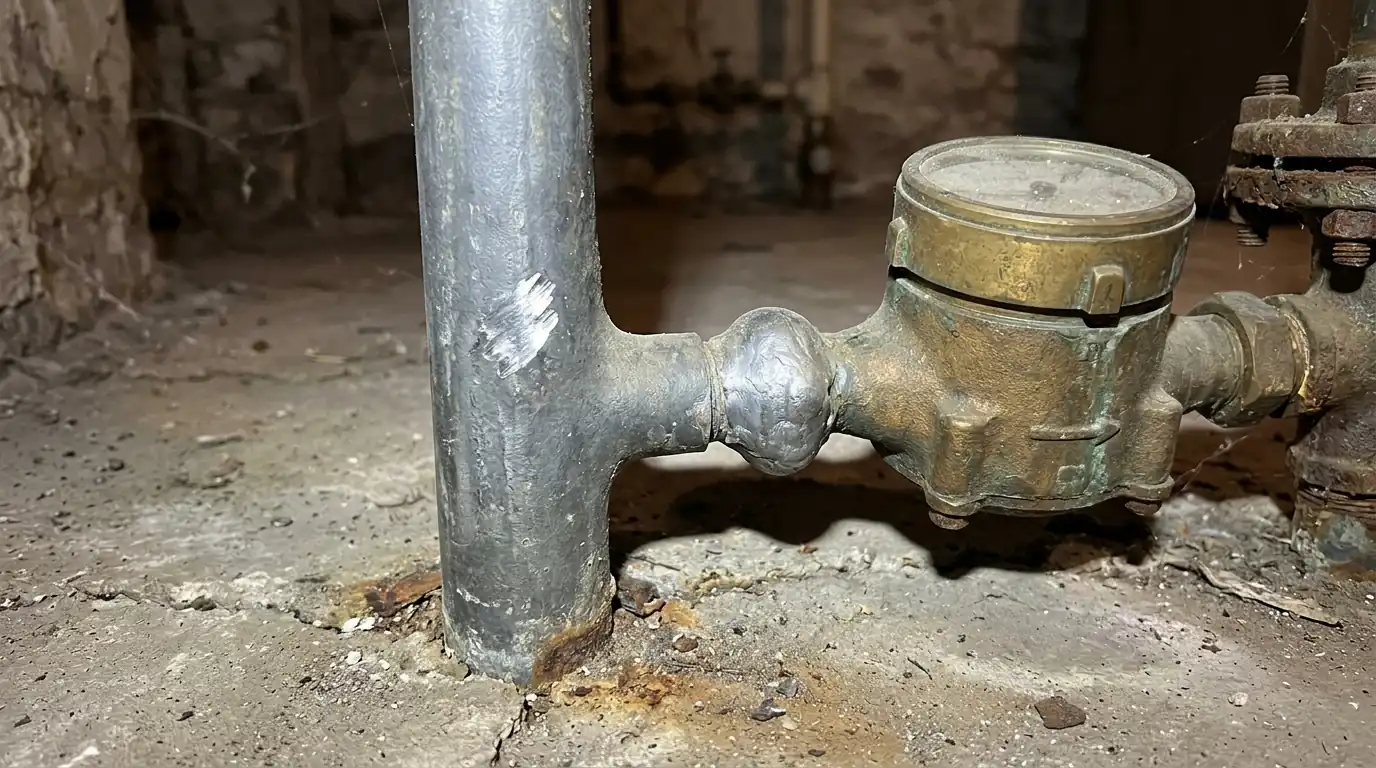
How to check the pipe at your meter
Go to the meter with a flashlight, a coin and a refrigerator magnet. Find the pipe coming up from the floor on the street side of the meter, before the main shutoff valve. Clean a small patch of it with the edge of the coin and look at the color underneath.
- Lead: dull gray outside, scratches to a bright silver, the magnet does not stick, and it often bulges at the joint like a knot.
- Galvanized steel: gray and rough, scratching shows gray metal, and the magnet grabs hard.
- Copper: scratches to the color of a new penny and the magnet does not stick.
- Plastic: black, blue or white pipe; less common on older Philadelphia service lines.
When the scratch test leaves you guessing
A lot of basements show a short piece of copper at the meter that was spliced onto older pipe under the floor. The copper looks reassuring, but the run under the sidewalk can still be lead or galvanized. Paint, insulation or a meter pit can hide the pipe entirely.
If the stub is copper but the house is old, or you cannot see bare metal at all, have a plumber look before you assume anything. We check the pipe at the meter, look at how it enters the wall and tell you plainly what we can and cannot confirm without digging. If you have a lead line, keep using a filter rated for lead at the kitchen tap and run cold water before drinking or cooking until it is replaced.
Rather have a plumber look at it?
We answer around the clock for Philadelphia, Montgomery County and lower Bucks County.
Call (267) 394-6446Four ways a lead line gets replaced
Owners in Philadelphia have more than one route, and the right one depends on timing, money and where you live.
- Hire a private plumber. PWD says this can cost between 3,000 and 12,000 dollars, depending on length, depth and what sits on top of the pipe.
- Use a HELP loan. PWD's Homeowner's Emergency Loan Program offers a zero-interest loan for lead service line replacement, repaid over 60 months on the water bill.
- Wait for main work on your block. When PWD replaces the water main on a block, it replaces lead and galvanized service lines free. Since 2017 it has replaced more than 2,600 lead lines this way.
- Check the pilot program. PWD's free Service Line Replacement Pilot was set to start in August 2026 in selected parts of North Philadelphia and West Philadelphia.
What a replacement day looks like
PWD notes that a service line usually takes 4 to 8 hours to replace. On a private job the plumber locates the curb stop, opens the ground at the street end, the house end or both, and either pulls a new line through or trenches it. The new pipe is connected to the main side, brought through the front wall, and finished with a new shutoff valve at the meter.
Water is off for part of that day. Afterward we flush the house lines through the faucets so loosened scale and sediment do not settle in aerators. If your interior piping is also galvanized, that is the moment to talk about repiping the house, because new copper feeding old steel only fixes half the trip.
Deciding whether to wait or replace now
Waiting for PWD makes sense if main work is scheduled and you can live with a filter in the meantime. Replacing now makes sense if the line is leaking, if you are selling or buying, or if young children live in the house and you would rather not wait on a schedule you do not control. The HELP loan exists precisely so the second choice does not need cash up front.
Whatever you decide, find out what you have. A quick look at the meter costs nothing, and our page on service line replacement covers the private route in more detail.
Questions owners ask
No. In Philadelphia the property owner is responsible for the water service line from the main to the house. PWD owns the main in the street.
Lead can leach from the pipe into water that sits in it, so a lead line is a real reason to act. Until it is replaced, use a filter rated for lead for drinking and cooking water and run the cold tap before using it.
Possibly. PWD replaces lead and galvanized service lines free when it replaces the water main on your block, and its pilot program covers selected parts of North and West Philadelphia. Outside those, the HELP loan spreads the cost over 60 months at zero interest.
PWD lists galvanized service lines among those that need replacement. Old galvanized steel rusts from the inside, which narrows the pipe, drops pressure and can break loose rust into the water.
Some digging is usually needed at the street end, the house end or both. How much depends on the method, the depth of the line and what covers it. We explain the plan before any ground is opened.
Not necessarily. Short copper pieces were often spliced onto older lead or galvanized pipe below the floor. A plumber can tell you how much of the line can be confirmed from the basement.