In older Philadelphia homes, a failing cast iron stack shows rust streaks or crust at the joints, hairline cracks running along the pipe, damp or stained walls where it passes through, sewer smells on upper floors and slow drains on several levels. A camera inspection confirms how far the damage runs before anyone opens a wall.
Why so many stacks here are still cast iron
Units built in 1939 or earlier make up 41 percent of housing in Philadelphia County, nearly twice the share of any other county in the region, and only 15 percent were built since 1980. Cast iron was the standard drain pipe for most of those years, so a great many homes in the city still drain through the original stack.
Cast iron lasts a long time, but not forever. It rusts from the inside, where wastewater and sewer gas sit against it, and the outside often looks fine long after the inside is thin. That is why the signs below matter more than the age of the house alone.
Start in the basement
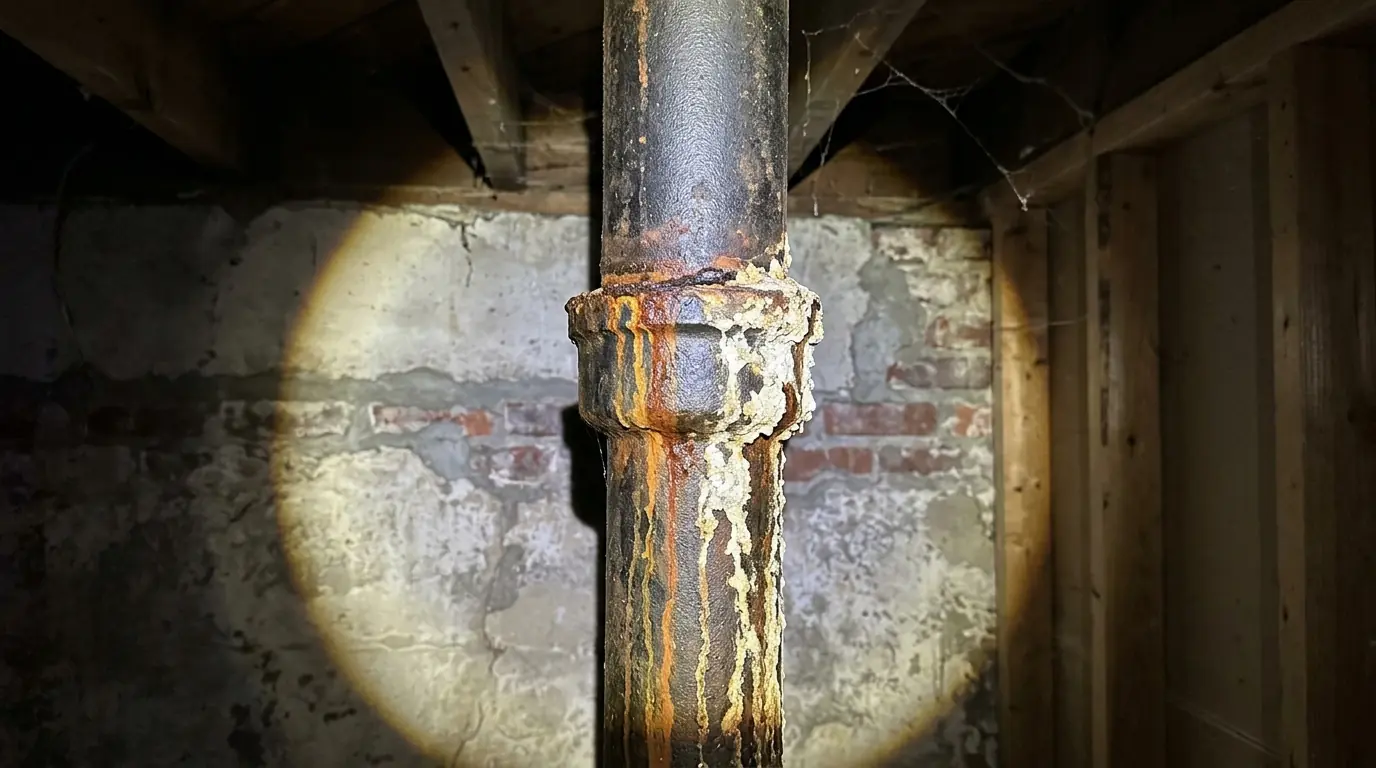
Take a flashlight to the bottom of the stack, where it turns from vertical to horizontal and heads toward the front wall. That bend takes the force of everything falling from upstairs, and it is often the first part to go. Look for:
- Orange or brown streaks running down from a hub joint
- White or rusty crust built up around a seam, a sign of slow weeping
- A fine crack running lengthwise along the pipe, which is how cast iron tends to split
- Flaking or blistered metal on the underside of the horizontal run
- A damp floor or a sewage smell near the base of the stack
- Old patches, clamps or tape someone added to stop a drip
What the walls upstairs are telling you
Above the basement the stack runs inside a wall or chase, usually behind a bathroom. You cannot see the pipe, but you can see what it does to the house around it. Paint that bubbles or peels along one vertical line, plaster that turns soft or crumbly, or a brown stain on the ceiling below a bathroom all point at water coming from inside the wall.
Smell is the other clue. A sewer odor in a closet or hallway that is not near any fixture often comes from a cracked stack or a failed joint letting gas into the wall cavity. Drain flies hanging around one room, with no dirty drain to explain them, can mean the same thing.
Rather have a plumber look at it?
We answer around the clock for Philadelphia, Montgomery County and lower Bucks County.
Call (267) 394-6446Drains that slow down on more than one floor
As cast iron corrodes, rust scale builds on the inside wall and narrows the pipe. Paper and grease catch on the rough surface, so clogs keep coming back in the same places. When the upstairs tub, the second floor sink and the first floor toilet all drain slowly, the problem is rarely three separate clogs. It is usually the stack, or the line at its base.
Gurgling is a related warning. The top of the stack is the vent that lets air in through the roof. If that vent is blocked or the pipe has a partial collapse, toilets and tubs pull air through their traps instead, and you hear it. If every basement drain backs up together, check the trap at the front wall too, as our house trap guide explains.
Confirming it with a camera
Owners can look and smell, but they cannot see inside the pipe. A camera inspection run down from the roof vent or in through a cleanout shows the scale, the cracks and the condition of each joint. It also tells you whether the trouble is one bad section or the whole stack, which is the question that decides the cost.
We record the run so you can see what we see, and we mark where the bad sections sit relative to the floors and walls. That makes the conversation about repair options concrete instead of a guess.
Section repair or full replacement
When one length or one joint has failed and the rest of the pipe is sound, we cut out the bad section and fit new pipe joined with shielded couplings. Before cutting, we support the stack above the cut with riser clamps so the weight of the iron overhead stays put. This kind of repair can buy many good years when the camera shows healthy pipe on both sides.
When the camera shows scale, thin walls and cracks along much of the length, patching one spot just moves the failure to the next joint. Then a full stack replacement makes more sense, usually in PVC from the basement to the roof, opened up through closets and chases where possible to limit wall damage. Many owners pair it with replacing old galvanized water lines while the walls are open.
When it cannot wait
Call right away if sewage is leaking from the stack, if a wall is wet enough to stain the floor below it, or if a crack is spreading. Stop using fixtures on the floors above the leak until a plumber has looked. A slow weep can usually be planned around; an active leak cannot, and we answer any hour.
Questions owners ask
Start at the basement where the large vertical pipe rises, then look for the pipe on the roof that sticks up above the bathroom side of the house. The stack runs in a straight or nearly straight line between them, usually inside a wall or closet behind the bathrooms.
Clamps and epoxy patches can stop a drip for a while, but cast iron that has cracked once is usually thin around the crack. A short section cut out and replaced holds far better than a patch. A camera shows whether the pipe on each side is sound enough.
Not always. If damage is limited to one section, usually the base bend or a single joint, a section repair is reasonable. If corrosion runs through most of the length, replacing it all at once avoids paying to open walls twice.
Cast iron is quieter, and PVC lets you hear water moving through a wall. Insulating the pipe in the chase helps. Some owners keep cast iron for the section beside a bedroom for that reason.
A crack or open joint in a drain stack lets insects and sewer air into the wall cavity. If there is no dirty drain nearby to explain them, ask for the stack to be checked.
Replacing a drain stack is a major drain change, and it usually needs a permit and inspection. We pull it when the job needs one.