To test for a leak in a Philadelphia home, turn off every fixture and water-using appliance, then watch the small low-flow indicator on the meter dial. If it turns while nothing is running, water is leaking somewhere after the meter. Closing the main valve on the house side then tells you whether the leak is inside the house or before that valve.
Know the three parts of the meter face
In most rowhomes the meter sits in the basement close to the front wall, near where the service line comes in from the street. Wipe the lid or glass clean and find three things.
The register is the row of numbers that counts water used, like an odometer. The sweep hand, on meters that have one, circles the dial as water passes. The low-flow indicator is the small one: a little triangle, star or toothed wheel that spins at flows too small to move the sweep hand much. A dripping faucet or a toilet that trickles will turn it. On some newer digital meters the same job is done by a flow symbol on the display that appears while water is moving.
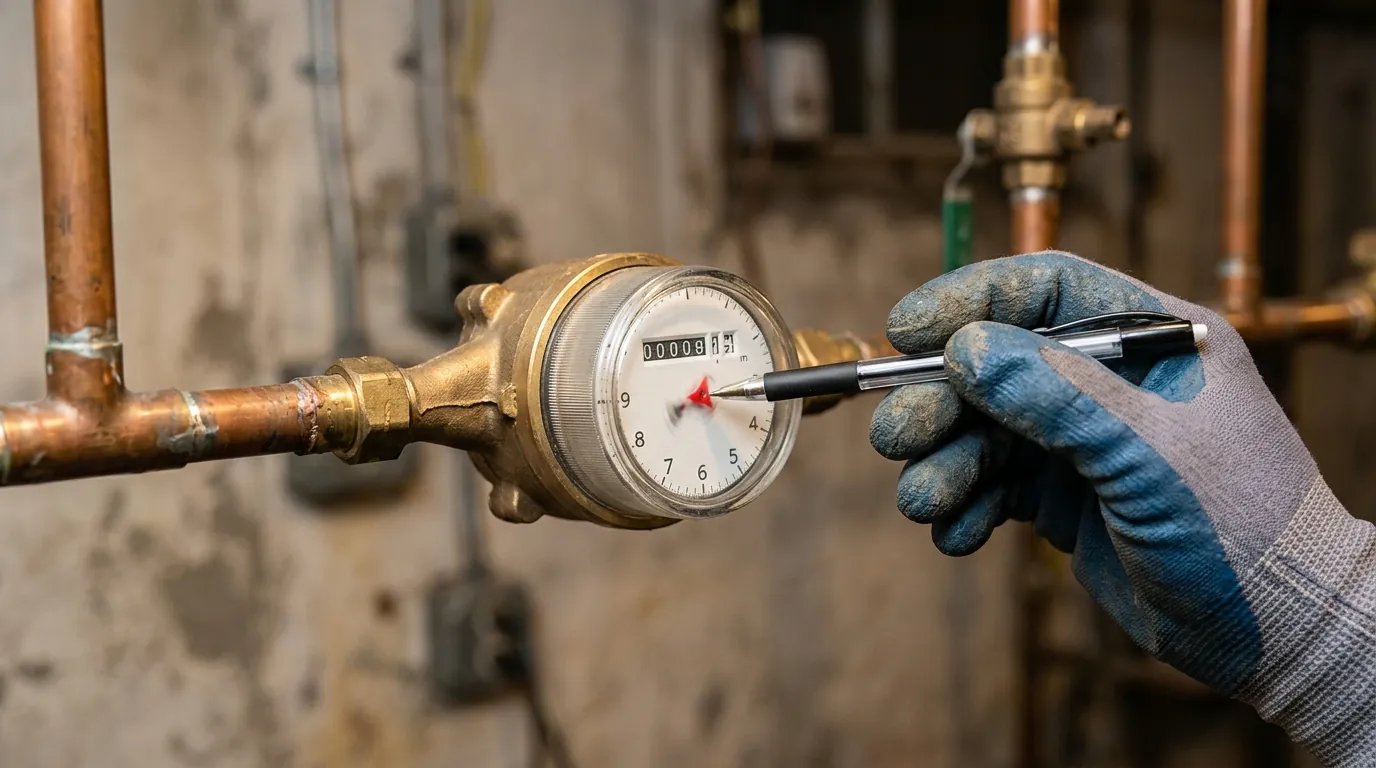
Running the first test
Pick a time when nobody needs water, such as late evening, and work through this list before you look at the dial:
- Shut every faucet, shower and outdoor hose bib
- Make sure the washer, dishwasher and any water softener are not mid-cycle
- Turn off the ice maker or close the valve feeding the refrigerator
- Shut off humidifiers or anything else tied into a water line
- Do not flush, and wait until every toilet tank has stopped refilling
- Write down the full register reading, then watch the low-flow indicator
What the indicator is telling you
If the indicator sits perfectly still, there is no measurable flow right now. For a slower leak, leave everything off for an hour or more, or overnight, and compare the register with the number you wrote down. Any change means water moved while the house was quiet.
If the indicator spins, something downstream of the meter is using water. That narrows things down a lot, because it rules out the meter itself and the service line coming in from the street. It does not yet tell you whether the leak is a toilet upstairs, a pipe inside a wall or something between the meter and your main valve. The second test splits that question.
Rather have a plumber look at it?
We answer around the clock for Philadelphia, Montgomery County and lower Bucks County.
Call (267) 394-6446Splitting the house with the main shutoff
Find the main shutoff on the house side of the meter, usually right after it on the same pipe. Close it, then watch the indicator again. If it stops, the leak is inside the house, past that valve. If it keeps turning, water is still getting through: either there is a leak on the short section between the meter and the valve, or the valve itself does not close all the way.
That second answer is more common than people expect. Old gate valves wear out and let water slip by even when the handle is cranked shut. A valve that will not hold is worth replacing anyway, since it is the one you need in an emergency. We do that as a shutoff valve replacement, usually swapping in a ball valve that closes with a quarter turn.
Toilets first, because they are usually guilty
Once you know the leak is inside, start with the toilets. A worn flapper lets water leak from the tank into the bowl around the clock, often silently. Put a few drops of food coloring in each tank, do not flush, and come back after a while. Color in the bowl means the flapper is leaking.
After the toilets, check under sinks, behind the washer, at the water heater relief valve and its discharge pipe, and at any outdoor spigot whose valve sits inside the basement. If all of that is dry and the meter still says water is moving, the leak is likely inside a wall, under a floor or in a line nobody can see. That is where leak detection with the right equipment saves you from opening walls at random.
Leaks the meter cannot see
The meter only counts water that passes through it. The service line from the curb stop to the meter is upstream, so a leak on that line will not move the dial at all, even while it soaks the ground under your sidewalk. Watch for a wet spot in the pavement or front yard that never dries, water seeping through the front basement wall near the meter, or pressure that has dropped for no clear reason.
That line matters to your wallet. In Philadelphia the property owner is responsible for the water service line and the sewer laterals that connect the house to the mains in the street. Drain leaks are also invisible to the meter, since wastewater has already been counted on its way in. Our service line guide covers what else owners should know about the pipe from the street.
Repeat the test after a hard freeze
Pipes are at greater risk of freezing and bursting when temperatures stay below 32 degrees for more than 72 hours, especially when water sits unused overnight. A line in an exterior wall can split during a cold snap and only start leaking once it thaws. Running this meter test after a long freeze is a quick way to catch that early.
Questions owners ask
A fast leak shows right away. For a slow one, compare register readings after an hour or more with nothing running, or run the test overnight. Any movement while the house is quiet means water is going somewhere.
In most rowhomes it is in the basement near the front wall, where the service line enters. In a finished basement it may sit behind a small access panel or inside a closet. If it is buried behind a wall, that is worth fixing, because you need to reach the main valve next to it in an emergency.
It can be. A toilet that refills a little every so often, called phantom flushing, will make the indicator jump in short bursts. Run the food coloring test on each tank before looking anywhere else.
No. The meter only counts clean water coming in. A leaking or broken drain shows up as smells, damp spots or slow drains, and a camera inspection is the usual way to find it.
Check whether the reading on the bill matches the register on your meter. If the meter shows no flow with everything off, the higher use may have come from a fixture that leaks only when in use, such as a running toilet after flushes. We can test fixtures one at a time if the cause is not obvious.
Yes, if it turns without force. If the handle is seized or the valve body is corroded, do not force it, since an old valve can snap or start leaking at the stem. Call us instead, and we can replace it while we are there.